
Seven Years, One Sky: American Airlines Returns to Caracas
After almost seven years of frozen airspace, an American Airlines jet flew the first scheduled commercial flight from Miami to Caracas this week.


Prelude: Tonada for the Reopened Sky
Seven years the cuatro waited, strings tuned to a closed horizon. Seven years the Ávila slept under another country’s weather.
The diaspora kept its altars — a tin of café, a Simón Díaz cassette, a phone number nobody dialed because the line, like the sky, had been severed.
Now an engine speaks Spanish again above the Caribbean’s blue manuscript. The plane is a thread, the thread is a country, the country is learning how to be reached.
Listen,
That hum is more than metal. It is a grandmother folding into her grandchild. It is a coffee farmer’s son returning with dollars and questions. It is the joropo the harp could not finish because the dancer had moved away.
The Ávila is awake.
Someone is brewing café at the gate.
Movement I: The Severance
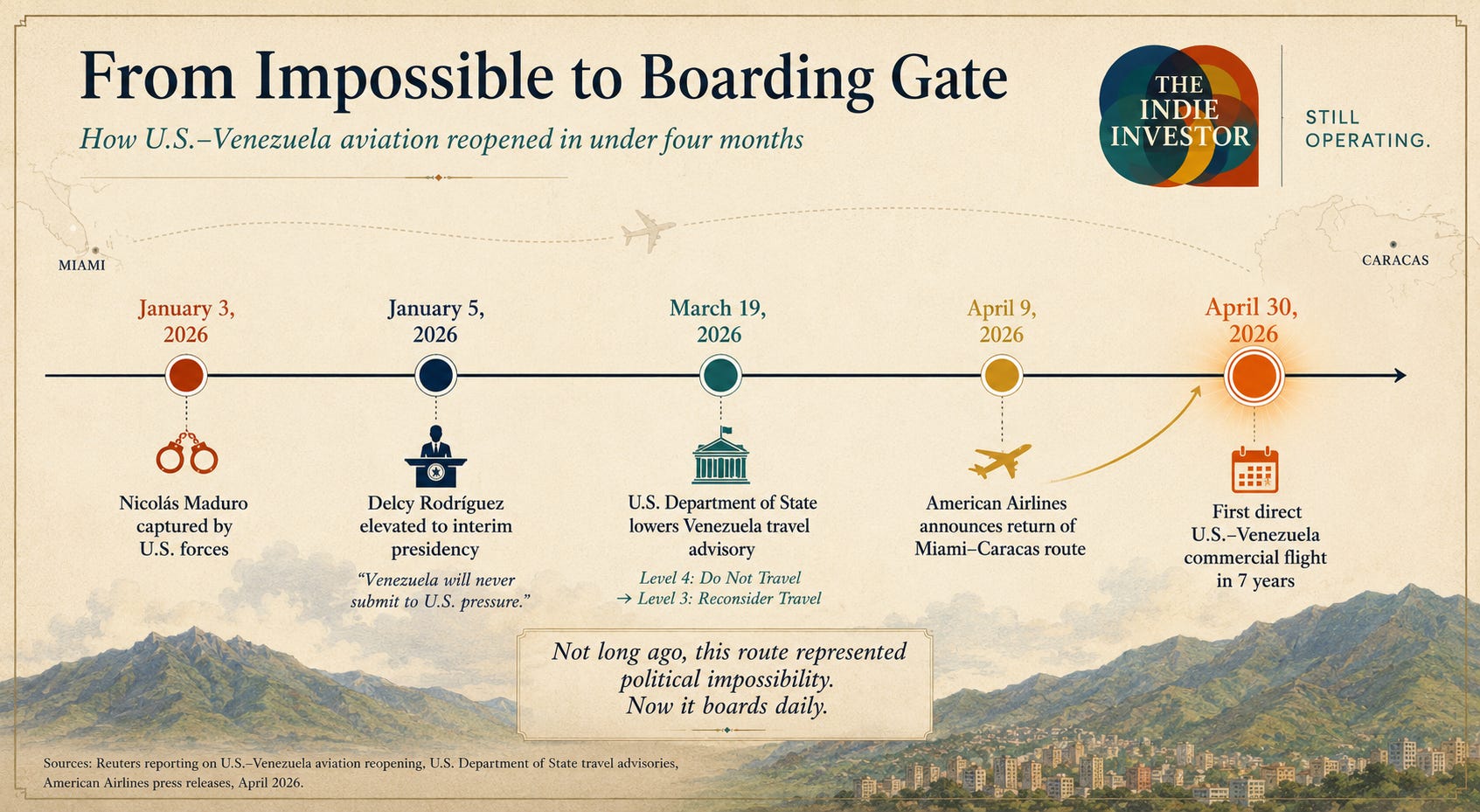
TLDR: Direct commercial air service between the United States and Venezuela was suspended in May 2019 by the FAA, citing security risk and a collapsing diplomatic posture. For nearly seven years the sky between Miami and Caracas was, in operational terms, closed. This week's flight is not a route launch. It is a re-stitching.
The airspace did not vanish. The sky did not move. What ended in the spring of 2019 was a relationship; one that for decades had been routine enough to be invisible.
Caracas → Miami.
Miami → Caracas.
The flight a Venezuelan executive took for a Tuesday meeting. The flight an abuela took twice a year to see grandchildren in Doral. The flight every diaspora carries inside its calendar.
When that flight goes away, distance returns.
Distance returns slowly, then all at once. A two-and-a-half hour hop becomes an itinerary through Bogotá, Panama City, Madrid — three days, six hundred dollars more, an entire visa regime to wade through.
The Venezuelan-American population in South Florida — the largest concentration outside Venezuela itself — learned to budget the trip as an expedition rather than a visit. Funerals were missed. Weddings were attended by Zoom. A generation of children grew up knowing their cousins through a phone screen.
Now, after the Trump administrations military efforts in the region, the route is open again.
As presented in a memo by the U.S. Department of Transportation on April 30, marketing the inaugural flight to Caracas;
“Today is about more than just another flight – it’s a critical milestone in strengthening the United States relationship with Venezuela and unleashing economic opportunity in both countries,” said U.S. Transportation Secretary Sean P. Duffy. “I am proud of our Department’s work behind the scenes to make this inaugural flight come to life, and I want to thank American Airlines for their continued commitment to servicing this essential aviation artery. Under President Trump’s historic leadership, the future of air travel between the United States and Venezuela has never been brighter. We can’t wait to expand on this progress and bring more flights online in the coming months.”
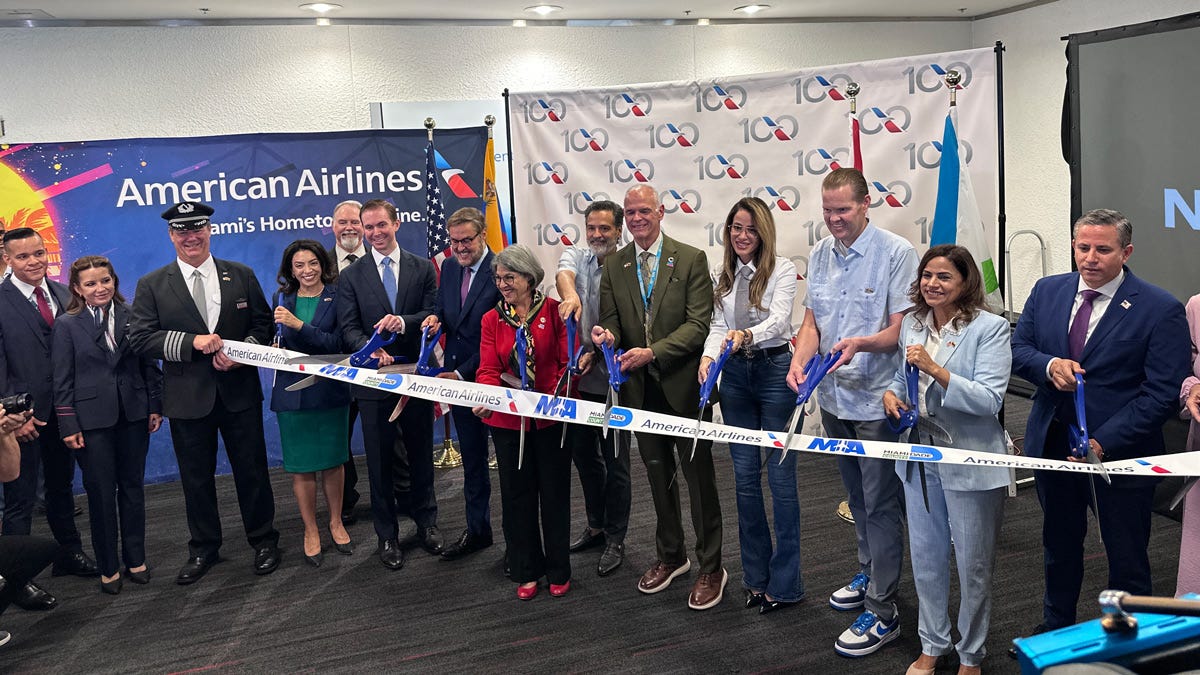
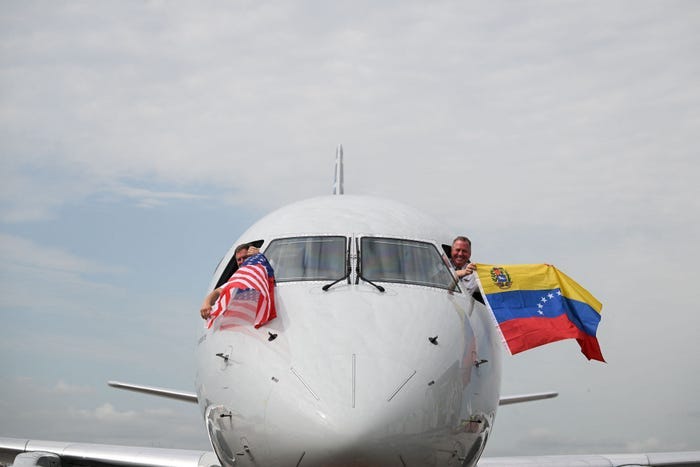
American Airlines, operated by Envoy Air on a Embraer 175 at 10:11 am on April 30, departed Miami International, cleared Maiquetía’s runway shortly after, and unloaded a manifest that the carrier and the airport had been quietly preparing for months.
The seven-year gap matters not just as a duration but as a generation of decisions. Every airline route is a verdict on what a market is worth. When the verdict is closed, capital reroutes. Remittance corridors fragment into informal channels. Family money moves through friends-of-friends. Investors who once flew down to walk a factory floor stop flying down. Whole categories of business including agricultural exports, oil services, telecom infrastructure; develop the deformed shape of a market that nobody can physically reach.

A reopened route does not undo seven years of distortion. But it is the first observable signal that the distortion is being priced out.
Movement II: How American Got the Route
TLDR: American Airlines was the dominant U.S. carrier on the Miami–Caracas route for the two decades before the 2019 suspension. When the U.S. Department of Transportation reopened the slots, AA's Miami hub, treaty seniority, and operational readiness made it the obvious, but not uncontested, choice.
International route awards are not, despite the marketing, gifts from a friendly capital city. They are the output of a quiet bureaucratic procedure that the flying public almost never reads. When two countries reopen scheduled service, the U.S. Department of Transportation issues a public order inviting U.S. carriers to apply for the available frequencies.
Each carrier files what amounts to a sales pitch:
Route economics
Projected ridership
Hub fit
Public-benefit argument
Other carriers may file objections. The DOT then selects.
For the Miami–Caracas route, the field had a clear front-runner before it formed.
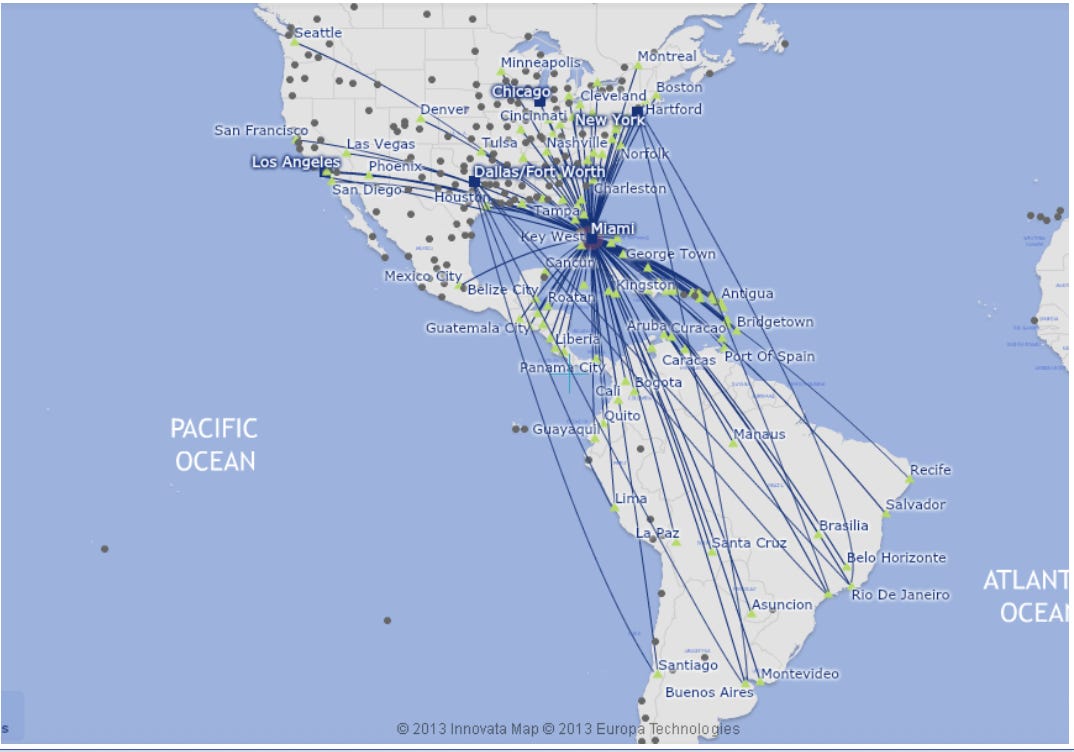
American Airlines operates the largest Latin American hub in the Western Hemisphere out of Miami International, with ~150 daily MIA Latin/Caribbean departures flights to roughly thirty countries below the Tropic of Cancer. Before the 2019 suspension, AA flew the Miami–Caracas pair multiple times a day and held the deepest commercial relationship of any U.S. carrier with Venezuelan corporate, government, and diaspora demand. The 2019 closure left those slot rights in suspended animation rather than extinct: the equivalent, in regulatory terms, of an option held but not exercised.
When the DOT reopened the proceeding on January 30, at this point the other major international US carriers (Delta and United), have not expressed bids publicly to develop their own routes.
The competitive case against AA was reasonable: a long absence implies a stale operation, and a reopening market arguably benefits from a fresh competitive entrant.
The case for AA was stronger: Existing crew familiarity. Existing ground handling agreements at Maiquetía. Existing Spanish-language customer service depth.
A Miami catchment that ranks first in the country for Venezuelan-American population. And a willingness, visible in the application, to commit to daily service from the first day of operation, which not every applicant could promise.
There is a quieter story underneath this one, and it is the part the indie investor should hold onto. Route awards are an early read on which corporate actors will price the recovery first. American Airlines is now the U.S. carrier with the most exposure to a normalizing Venezuelan economy: exposure denominated in seats sold, cargo holds filled, frequent-flier accounts re-activated.
The market has a habit of treating airline route maps as lagging indicators. They are often leading ones.
Movement III: The Manifest
TLDR: The first flight back is rarely a representative cross-section of who will ultimately fly the route. It is a curated convoy: diaspora returning to surviving family, journalists, executives scouting reopening verticals, NGOs and aid coordinators, and a small corps of citizens who happened to book the cheapest seat at the right moment. Each cohort tells a different story about what reopens first.
Talk to the passengers and a typology emerges.
The largest single cohort is diaspora. South Florida holds ~250,000+ Venezuelan-Americans, and the seven-year air closure left a backlog of personal logistics; aging parents, siblings who never made the asylum trip, properties to inspect, weddings to convene. The diaspora passenger flies with two suitcases of medication and a third of clothes. The first cabin to fill on any reopening flight is the one carrying inventory the home country cannot reliably provide. Pharmacies travel on this plane. So do replacement parts for a sister’s blender, a grandfather’s hearing aid, and the prescription glasses that took three years to arrive by mail.
The second cohort is informational. Journalists, researchers, NGO coordinators, election monitors, multilateral bank staff. These passengers are paid to be the eyes of institutions that cannot yet open offices. Their per-diem economy is an early-stage market in itself: hotel demand near Altamira / Las Mercedes, translator and fixer rates, ground transport from Maiquetía to the capital. The hospitality sector reopens before the consumer sector, because the institutions buying rooms are funded by capital that priced this trip months ago.
The third cohort is commercial. Latin American regional bankers. Energy services scouts whose firms held assets in suspension during the closure. Agricultural traders. A handful of crypto-and-remittance operators whose business has been routing dollar liquidity around the closed corridor and who now need to understand whether they will compete with — or partner with — newly reachable formal banking. These are the passengers whose conversations are the quietest and whose decisions in the next ninety days will be loudest. A reopening market is a footrace among people with capital who do not yet know how the rules work.
The fourth cohort is the one the headlines will frame the story around: the family stories. The grandmother holding a photograph of a granddaughter she has never met in person. The young engineer returning to bury a father whose funeral he watched on a phone. The musician carrying a cuatro he bought in Doral, going home to play it. These are the human stories that will dominate next week’s coverage. They are real, and they are not the whole picture.
The fifth cohort is the one nobody photographs. The passenger who bought a $389 fare on a Tuesday because it appeared in a fare-tracker alert and they are simply curious. They are tourists, in the most ancient sense; people who go because the going is now possible. There will be more of them next month than this month, and far more next year than this year. They are the demand curve becoming visible.
The plane that leaves Miami this week is not a marketing artifact. It is an inventory of what was suppressed. Watch what unloads at Maiquetía, and you can read the first sentence of the next chapter of a national balance sheet.
Finale: A Field Guide for the Indie Investor
Reopening markets reward the patient and humiliate the hasty. Here is how to think about this one without getting either burned or left out.
Watch the frequency before the fare. The headline is the route. The signal is the schedule. A daily flight that becomes twice-daily within ninety days is a market validating itself. A daily flight that quietly drops to four-times-weekly is a market the operator has misread. Frequency changes are public information; subscribe to AA’s route updates and the DOT’s docket.
Read the cargo manifest, not the passenger list. Belly cargo on the first wave of reopening flights is the most honest demand indicator a market produces. Pharmaceuticals, electronics, replacement parts, perishables, the order in which they fill the hold tells you which sectors of the home economy have been suppressed by the air closure and which will reopen first. Cargo data is harder to find than ticket data, but it is what professional emerging-market investors actually trade on.
Identify the second-order beneficiaries before the first-order ones are priced. AA’s stock will move on the route. So will local providers, who operate the local concessions across the domestic/international terminals and local areas as larger conglomerates (such as SSP and HMSHost — who operate as some of the largest Latam food service groups), as well as Dôme Duty Free, who in September 2024 expanded their Duty Free offerings across Latin America including a branch in Caracas .
Less obviously: U.S. money-transfer firms with Venezuelan corridor exposure, U.S.-listed Latin American banks with regional Caribbean basin franchises, Venezuelan ADRs (still trading, historically thin), regional telecoms whose roaming agreements have just been re-priced. The first order is on CNBC by Friday. The second order is where the indie investor still has time.
Beware the political volatility discount. Every reopening market trades at a discount because political reversals are real. The discount is not always wrong. Size positions accordingly. The mistake retail investors make in reopening narratives is treating the reopening as a one-way ratchet. It is not. It is a set of probabilities that has shifted, not collapsed.
Treat the diaspora as a leading indicator. South Florida’s Venezuelan-American community has more current information about on-the-ground conditions in Caracas than any sell-side analyst will publish in the next six months. The remittance volumes, the WhatsApp groups, the church bulletin boards in Doral: these are primary sources. An investor who reads them, even imperfectly, is closer to the ground than an investor who waits for an MSCI inclusion announcement.
Hold the human story alongside the financial one. A route is reopening because two countries decided, for the moment, to let people see each other again. Whatever happens to the trade in the coming quarters, that is the part of the ledger that matters. Capital should circulate. So should families. So should music. The cuatro on the overhead bin is part of the manifest too.
The reopened sky is an asset class, yes. But it is also an answer to a seven-year question — can we reach each other? — and the answer this week, for the first time in a long time, is yes.