
Why the Factory Is Starting to Look Good Again
On corporate decline, industrial resurgence, and the shifting value of work in modern America

Prelude: The Shift That Still Pays
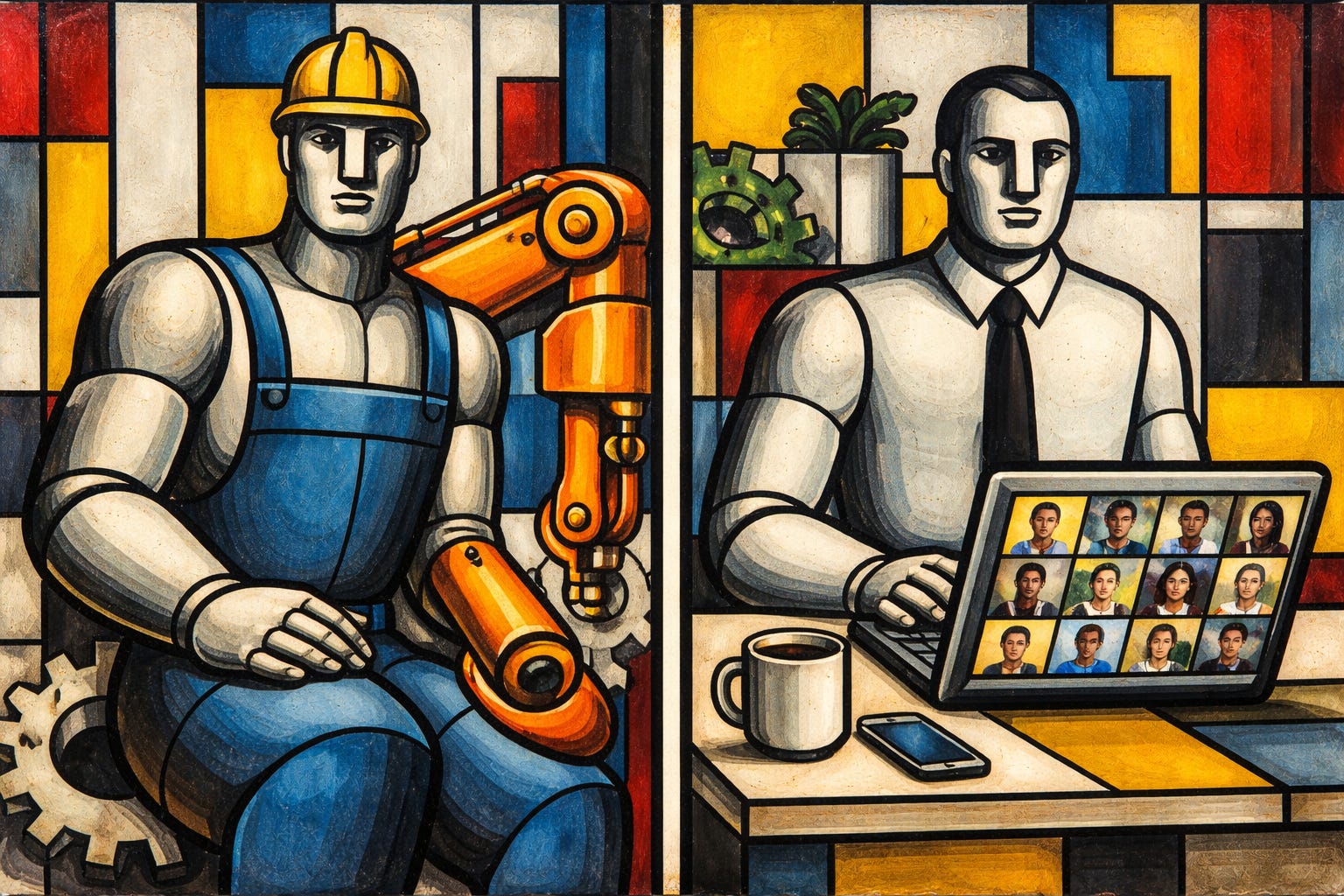
Before the sun rises, the parking lot begins to fill.
Headlights sweep across rows of cars arriving at nearly the same time,
engines cutting, doors closing, a quiet rhythm forming before the work even starts.
Inside, the building is already awake—fluorescent lights steady,
machines easing into motion as the line prepares to move.
A clock hangs where everyone can see it.
Work settles into the body—lift, place, repeat—
until time becomes something you can measure without looking.
When the shift ends, it ends.
The noise fades, the doors open, and the day resumes outside.
Across town, the day begins without a boundary.
A laptop opens to a calendar already full,
meetings stacked tightly enough to remove the space between them.
Faces appear, voices replace one another,
and the work continues without the need to move.
There is no hallway, no distance, no pause to reset.
The friction is gone, and with it, the signal to stop.
The clock remains in the corner of the screen,
but nothing around it acknowledges the passing of time.
On the floor, the line still starts and stops.
In the office, the day closes without leaving.
And somewhere between the two,
the question is no longer which work is harder
but which one is finished.
Movement I: The First Middle Class Was Built on the Floor
TLDR: Mid-century manufacturing jobs created a stable, single-income middle class, but globalization and automation eroded that model. As the factory's promise faded, stability shifted to the office — setting up the cycle to unravel again.
Before the office became the symbol of stability, the factory held that role.
Mid-20th century America built its middle class on industrial labor. Manufacturing jobs were not just abundant but were foundational. At their peak in the late 1960s and early 1970s, manufacturing accounted for roughly 25–30% of total U.S. employment. These were not peripheral roles. They were the core of economic life.
The structure of that work mattered.
Factory jobs offered predictable wages, defined hours, and a direct relationship between effort and output. You showed up. You completed the shift. You were paid. That clarity extended beyond the job itself. It enabled planning. It enabled stability. It enabled a version of life that could be built on a single income.
Data reflects this alignment: In 1960, nearly 70% of American households were supported by a single income. Homeownership rates climbed steadily through the postwar period, reaching over 60% by the early 1960s and continuing upward. The combination of industrial wages and constrained living costs created a system where one job could support a household, finance a home, and sustain a family.
This was not universal as it excluded many. But for those within the system, it was coherent.
Then the model began to fracture.
Beginning in the late 1970s and accelerating through the 1980s and 1990s, manufacturing employment declined as a share of the workforce. Globalization redistributed production. Automation reduced labor intensity. The same forces that increased efficiency also reduced the number of workers required to sustain it. By 2020, manufacturing employment had fallen to roughly 8–9% of the U.S. workforce.
Wages did not collapse overnight, but their purchasing power eroded relative to the cost of living. The relationship between labor and life weakened. A single income no longer reliably supported a household. Dual-income families became the norm. The factory did not disappear, but its promise did.
And with that shift, the center of gravity moved.
The stability that once defined industrial work migrated toward the office. Corporate roles, particularly in professional services and technology, began to offer what manufacturing once had: predictable income, benefits, a path to upward mobility. The office became the new site where a life could be built.
For a time, the transition held.
But the underlying pattern remained the same. The job that anchors the middle class is not fixed. It moves with the structure of the economy. And when the structure changes, so does the definition of what counts as stable work.
Movement II: The Corporate Worker Became the New Factory Worker
TLDR: Corporate work replaced the factory's structure with flexibility, then removed its boundaries entirely. What looks like autonomy is increasingly a system of continuous visibility, fragmented time, and work that never formally ends.
The office did not just replace the factory. It inherited its structure, then dissolved its boundaries.
For a time, corporate work improved on the industrial model. It offered flexibility, autonomy, and a sense of upward mobility that felt unbounded.
The clock was no longer punched. The workday stretched, but it also softened. Movement between meetings required friction. Time existed between tasks, even if it was only the walk from one conference room to another.
Then the system optimized.
The pandemic removed physical constraints. Meetings no longer required rooms, movement, or transition. Between 2019 and 2021, the share of Americans working primarily from home tripled; from roughly 5.7% of the workforce to nearly 18%. By mid-2023, about one in five workers was teleworking on any given day, a figure that has since stabilized. Calendars compressed. What once required space between now stacked without resistance. Back-to-back meetings became default. The absence of friction became a form of pressure.
Time did not expand but instead became neatly filled in Outlook and G-Cal.
This is also where flextime reveals its hidden edge. Marketed as worker empowerment, flexible scheduling in the knowledge economy has quietly redefined what “part-time” and “available” mean.
A growing body of research has identified what scholars call the “flexibility paradox”: workers given flexible schedules often end up working more hours, not fewer. The schedule becomes elastic in one direction only. What was sold as control over your day becomes a condition in which every hour of the day is potentially a work hour. Researchers studying this dynamic have found that unlimited schedule flexibility is associated with longer paid working hours, not shorter ones and the effect is more pronounced for workers in lower-leverage roles, where “flexibility” often means absorbing whatever the organization needs without the title or pay to match.
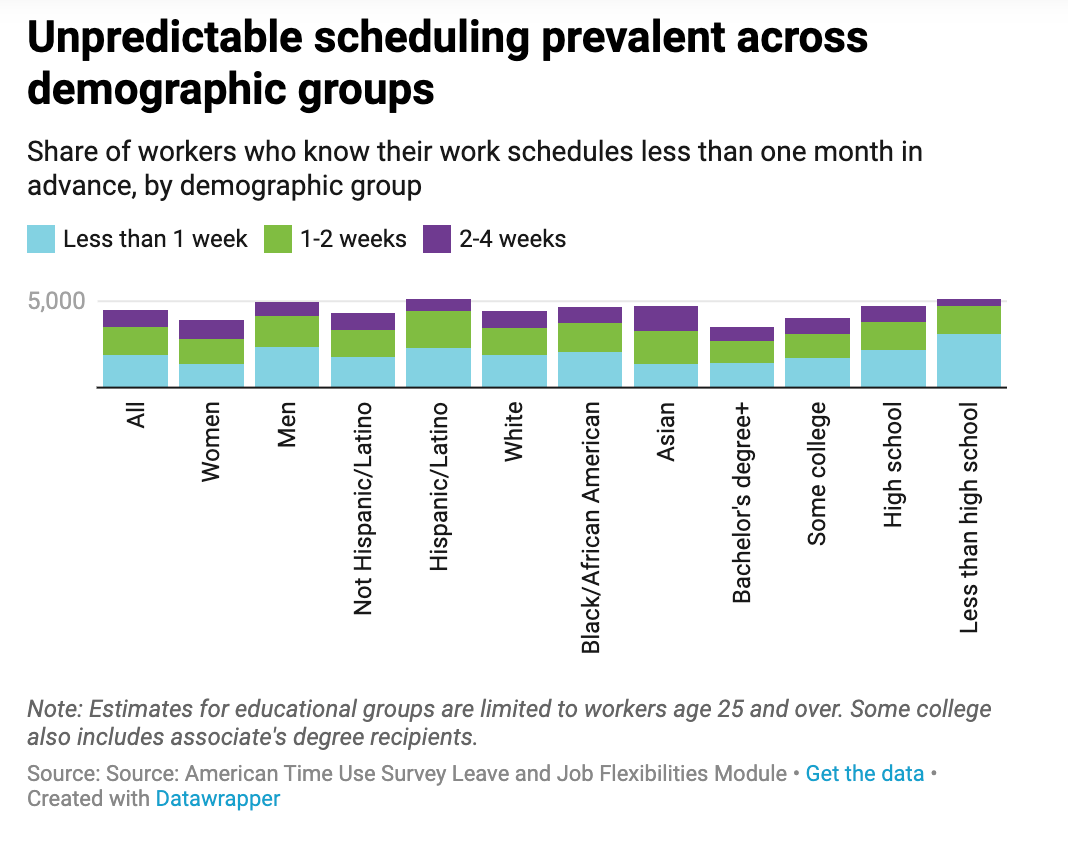
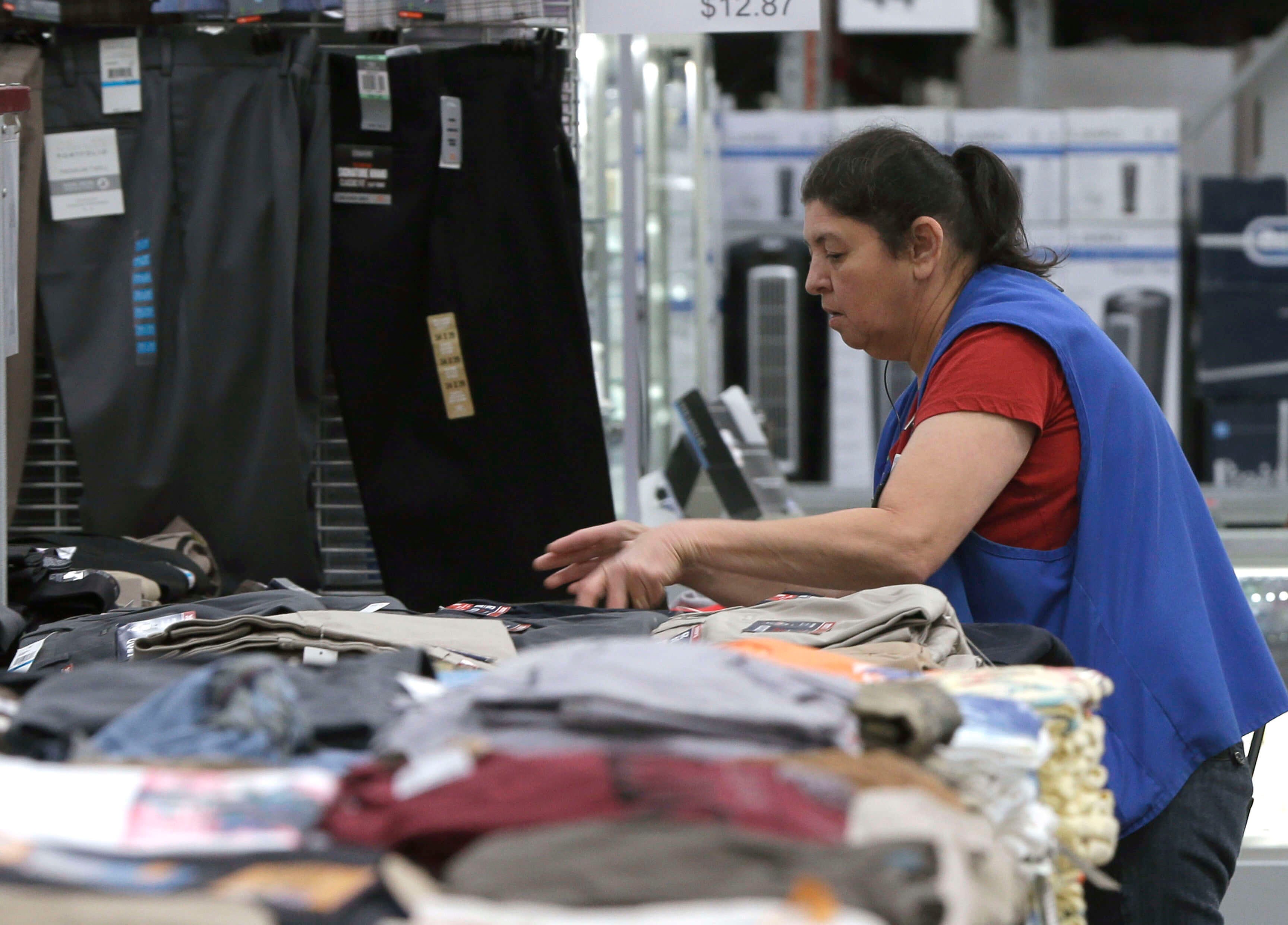
A related pattern has emerged in explicit scheduling practices. Variable or on-call scheduling in which workers are contracted for 20 hours, but expected to remain available for 40, has spread well beyond the retail and service industries where it began. The logic is familiar: keep a pool of partially-paid workers on standby to absorb demand fluctuations. The cost of that standby is transferred entirely to the worker, in the form of unpredictable income, blocked personal time, and a schedule that cannot be planned around.
Research from the Economic Policy Institute and Brookings Institution has documented how widely these practices have spread, and what they cost the workers subject to them: difficulty securing childcare, inability to take a second job, income volatility that compounds over time.
At the same moment, a second layer of surveillance emerged in corporate work. Not visible, but measurable. Keystrokes tracked. Activity logged. Response times analyzed. Productivity quantified through proxies that stood in for output. Software began to observe what managers once inferred.
The office, in becoming digital, became legible, but legible to the employer, not the worker.
This is not framed as control but it is framed as efficiency. The language is softer: alignment, visibility, performance. But the effect is familiar. Work is no longer bounded by a shift. It is defined by continuous availability, measured in real time. The corporate worker, once removed from the cadence of the factory, begins to feel something similar: not in form, but in function.
Expectations become implicit. Authority becomes diffuse but absolute. The instruction is no longer given directly. It is embedded in systems, dashboards, and calendars that leave little room for refusal.
Do it because it is scheduled.
Do it because it is tracked.
Do it because the system reflects that it should be done.
What was once “because I told you” has been rewritten as process. And in that rewrite, something was lost. The factory defined work by the hour. The office now defines it by presence. One ended when the shift was over. The other continues as long as the signal is active.
The boundary did not disappear. It was absorbed.
It is worth noting that not every corporate role has followed this path equally. High-autonomy positions — senior individual contributors, certain technical specialists, some remote roles with genuine output-based evaluation — retain meaningful control over time. The trend is real, but it is not total. The point is not that all office work has become boundary-less, but that the conditions that once distinguished corporate work from factory work have eroded enough to change the comparison.

Movement III: The Factory Quietly Got Better
TLDR: Factory work hasn’t universally improved, but it has become safer, more structured, and more predictable; preserving clear boundaries that corporate work has increasingly lost.
The factory did not return to what it was. It changed in ways that are easy to miss if you’re not looking for them.
Industrial work is still physical. It is still constrained. It is still, in many cases, demanding. But across several dimensions, the conditions surrounding that work have improved over time, even as its cultural status has lagged behind.
Safety is the clearest example. Workplace injury rates in manufacturing have declined significantly over the past few decades, driven by regulation, enforcement, and automation. OSHA standards expanded. Processes were formalized. Tasks that once required repetition under strain are increasingly assisted or replaced by machines. The work did not disappear, but the risk profile shifted.
The question of mortality sits at the center of this comparison, and it deserves a direct look. Research consistently shows that factory workers face higher mortality rates than professionals and that gap is real. A landmark study of UK occupational mortality tracking 60 occupation categories across two decades found mortality rates differing by more than three times between the highest- and lowest-risk groups, with factory workers and elementary construction workers at the high end and health professionals, teachers, and business managers at the low end. Similar patterns appear in U.S., Japanese, South Korean, and European data. This is not a finding to dismiss.
What the research also shows, however, is that these mortality differences are not attributable solely to the physical demands of the work itself. Socioeconomic position, lifestyle factors, access to healthcare, residential environment, and the cumulative effects of decades of lower income all contribute. A study in the Frontiers in Sociology journal found that workers with physically strenuous jobs at age 55 had a life expectancy roughly 1.5 to 2 years shorter than their less-strenuous counterparts, a real gap, but one that also reflects lifestyle and class concentration, not job physicality alone.
The trend, critically, is moving in the right direction. Occupational injury and illness rates in manufacturing have declined substantially since the 1990s. The gap between blue- and white-collar mortality, while still present, has been narrowing as manufacturing conditions improve and as the health consequences of corporate work; particularly chronic stress, sedentary behavior, and the effects of unbounded hours become better understood.
Compensation tells a more nuanced story. Manufacturing wages have not outpaced the highest-paying corporate roles, but in many regions they have stabilized relative to other non-degree occupations. In skilled trades and advanced manufacturing, wages have quietly risen as the supply of qualified workers has tightened. The premium is not universal, but it is real in pockets.
More importantly, the structure of the work has remained intact.
A shift begins.
A shift ends.
Expectations are visible.
Output is measurable.
When the workday is over, it is over in a way that does not require interpretation. The boundaries that once defined industrial labor still exist, even if the work itself has evolved.
This is where the comparison becomes less about absolute quality and more about relative experience.
Corporate work expanded in flexibility, then dissolved its limits. Industrial work retained its limits, and in doing so, preserved something else: separation.
This does not make factory work easy.
It does not make it universally desirable.
There are plants with poor safety cultures, exploitative scheduling, and wages that have not kept pace.
The trend is toward improvement, but a trend is not a guarantee, and exceptions are real. The point is not that every factory job is preferable to every corporate role. It is that the conditions that once made manufacturing categorically unattractive have changed, while the conditions that once made corporate work categorically attractive have also changed. The comparison is no longer what it was.
And legibility has value.
In a labor market where expectations are increasingly implicit, where performance is continuously observed but rarely clearly defined, the appeal of work that is bounded begins to re-emerge. Not as nostalgia, but as contrast.
The factory did not become aspirational, It became understandable again.
The Indie Investor Field Guide: A Field Guide to the Repricing of Work
Work is not just changing. It is being repriced across dimensions that were once taken for granted. Stability, time, and clarity are no longer evenly distributed across roles. They are shifting, and with them, the definition of what makes work valuable.
For those operating inside this system—building companies, allocating capital, or navigating careers—the advantage is not in predicting where prestige will go. It is in recognizing where conditions are stabilizing.
1. Track where boundaries still exist
Roles with defined hours, measurable output, and clear expectations are regaining value. Not because they are easier, but because they are legible. In an environment where work expands to fill available time, constraint becomes an asset.
2. Separate status from quality of life
High-status roles no longer guarantee stability, compensation growth, or control over time. The signal has decoupled from the outcome. Evaluating work through prestige alone obscures where the actual advantages sit.
3. Watch how companies absorb pressure
When conditions tighten, organizations adjust somewhere. It may show up in hiring, compensation, expectations, or monitoring. Understanding where that pressure is absorbed reveals how sustainable a role or structure actually is.
4. Pay attention to the return of physical systems
Industries tied to infrastructure—manufacturing, logistics, energy—are being re-evaluated as digital work becomes more abstract and less bounded. These roles may not carry the same cultural weight, but they are regaining economic clarity.
5. Redefine what “good work” means
Security, time control, and compensation are no longer aligned in a single category of jobs. Each must be evaluated independently. The roles that balance them, even imperfectly, are becoming more competitive.
The shift is not about one type of work replacing another. It is about the criteria changing underneath both.
Work did not become worse.
It became miss-priced.
And when something is miss-priced, it does not stay that way for long.