
We Forgot How to Price For the Masses
What Brands Are Telling You When They Stop Pricing for You

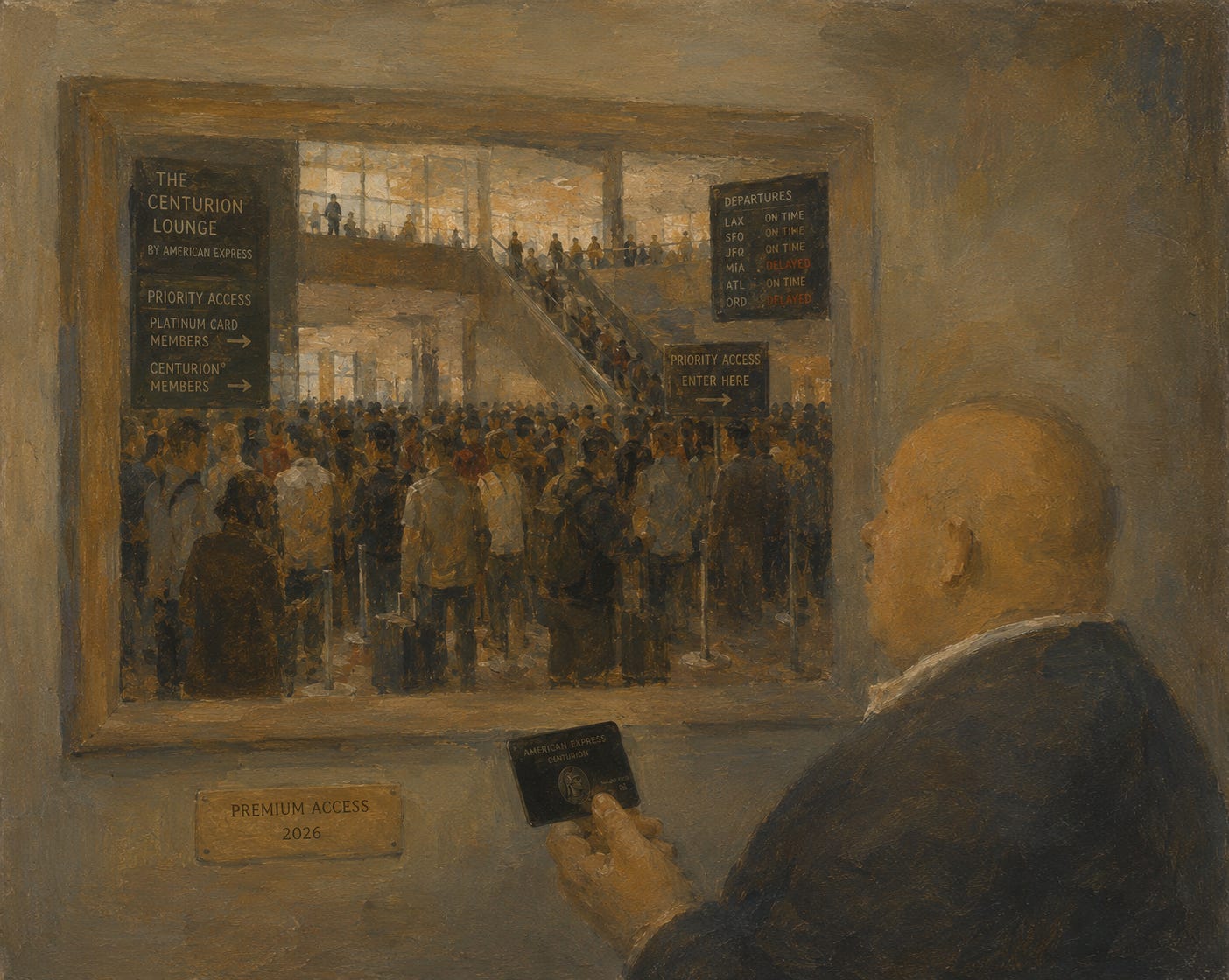
Prelude: Admission
In the beginning, price was honest.
A dollar for flour, three for a loaf,
The merchant’s hand opened, the customer’s too.
There was understanding in that transaction—
I have this.
You need it.
We both know its worth.
But somewhere in the ascent,
Somewhere between scarcity and screen,
Price learned to lie.
Not in the number itself
The number is ruthlessly true
But in who it’s meant for.
A lounge once promised.
A cabin once exclusive.
A membership once rare.
Now a line at the gate,
Now a waitlist with other exclusivist names,
Now a benefit that costs them nothing to degrade.
What does it mean when a brand
Stops building for the many
And starts extracting from the few?
When access, the only product
And access, by definition, disappears the moment you’re let in?
Price, then, is not a number.
It is a choice.
A choice about who is worth serving.
A choice about whether you believe
Your margins are bigger when you shrink your tent.
Movement I: The Arithmetic of Appetite
TLDR: Brands aren't raising prices to cover costs, but they're raising them to narrow their customer base. With over 24 million millionaires now in the U.S. (and counting), vendors have found a more profitable math: serve fewer, charge more, maintain exclusivity. The question is what they're sacrificing in the trade.
In 1984, the economist and social scientist Diane Ravitch observed something that has become a governing principle of 21st-century commerce: scarcity creates desire, but abundance creates belonging. The luxury goods market has inverted this entirely.
There exists a peculiar economic inflection point we’re experiencing right now. The United States added nearly 379,000 millionaires in 2024 alone — more than any other country that year. We’re currently home to roughly 24 million millionaires, representing 8.8% of the adult population. Demographic projections suggest that figure will reach 24.5 to 27.7 million by 2026.
Over 1,000 people become millionaires in America every single day.
This is not a top-heavy concentration of unimaginable wealth. This is a substantial cohort—a new “majority minority,” to use a term from demographic studies. These are the orthodontists, the tech middle managers, the successful service entrepreneurs, the real estate appreciators. They’re not billionaires. They’re not old money. But they have roughly $1 million in net worth, and crucially, they have active capital they can deploy.
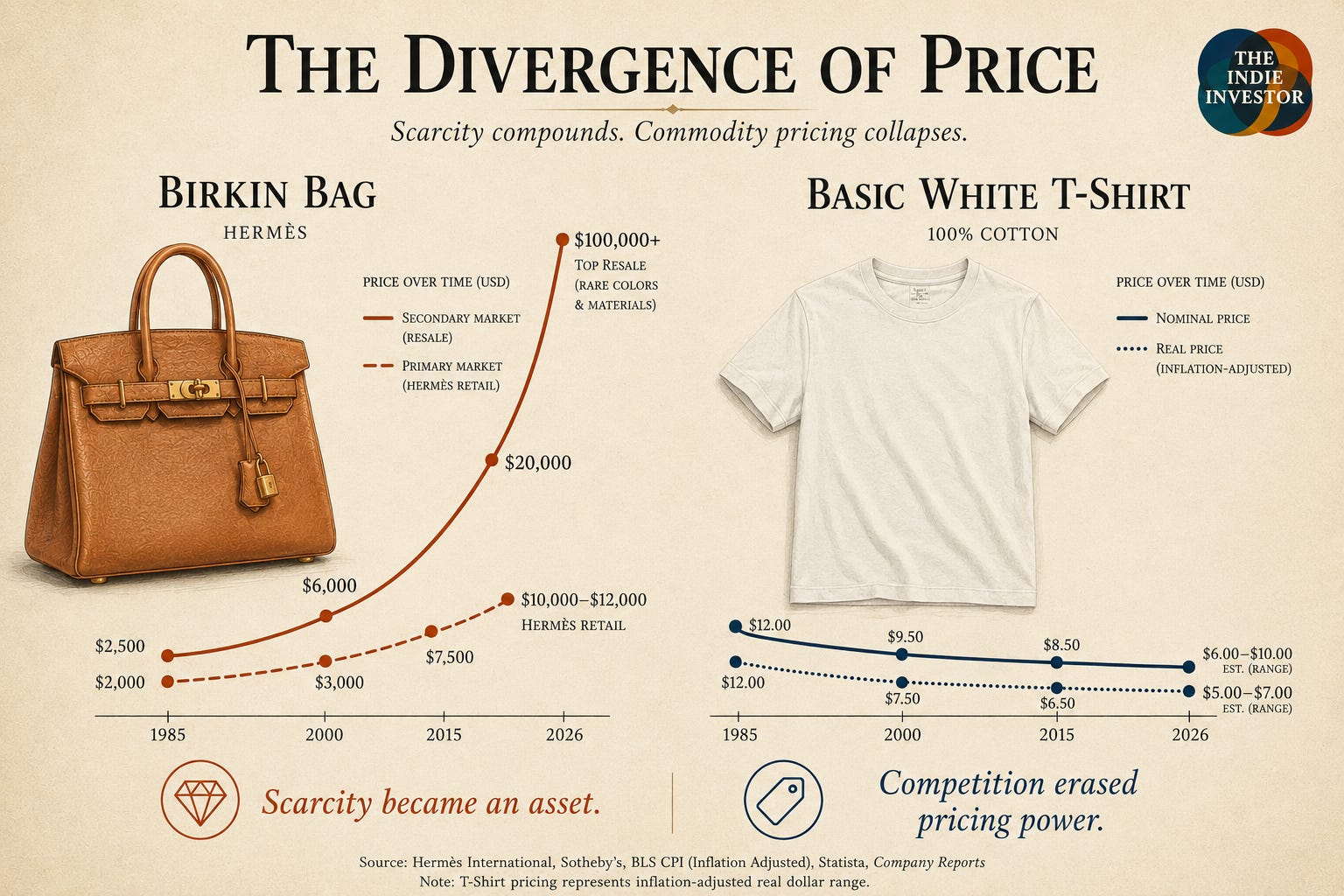
Brands have noticed.
The strategic calculation is now inverted: instead of maximizing profit through volume, vendors are finding more efficient returns by maximizing price through selectivity.
The Platinum card becomes saturated, so AmEx creates the Centurion. When Centurion lounges fill beyond capacity — once exclusive, now indistinguishable from an airport terminal with slightly better crackers — they don’t expand the experience. They degrade it, or introduce friction (waitlists and guest restrictions), or they simply stop serving you as well. The message is implicit: you shouldn’t be here.
This isn’t accidental. This is pricing strategy, and it’s working.
The mathematics are irrefutable. If you can serve 50 customers at $100 each, your revenue is $5,000. But if you can serve 5 customers at $1,000 each — and you can, because there are millions of them now — your revenue is identical while your operational burden drops dramatically. Fewer seats to fill. Fewer customers expecting quality. Fewer refunds. Fewer complaints that reach public consciousness.
But there’s a second-order effect: the customer base above the line grows, and the customer base below it shrinks faster.
Movement II: When Exclusivity Becomes The Product
TLDR: Luxury brands used to differentiate through quality. Now they differentiate through access. The product is no longer the seat but the knowledge that someone else can't have it. This changes everything about how value is created, and who it's created for.
Walk through any airport and you’ll witness a curious inversion. The first-class cabin used to be the plane’s most functional space. Wide seats, better food, attentive service. It was expensive because it was genuinely better. Now, the distance between economy and business class has compressed dramatically. Both serve the same meal in the same cabin, separated only by a curtain and a price point that can vary by 400%.
What’s actually being sold is not the seat. It’s the differentiation.
The best case study of this principle is, paradoxically, also its most public failure: the American Express Centurion Lounge.
Centurion lounges were once considered the gold standard of airport hospitality. They were chef-driven, limited in access, and they forced competing airlines and card issuers to elevate their entire game. The American Express Platinum card gained much of its cachet simply by proximity to the Centurion program. It wasn’t just a lounge: it was a statement about who you were.
Then demand shifted. More people qualified. More people wanted access. AmEx, seeing an opportunity, expanded the program. They added more lounges, more capacity, relaxed the restrictions incrementally. The product remained nominally identical, but the exclusivity evaporated. By 2025-2026, Centurion lounges had become, in the words of frequent travelers, “packed beyond capacity.” The service degraded. The waitlists appeared. AmEx began restricting guest access and discontinuing partnerships (Lufthansa first-class lounge access, which used to come with Centurion membership, will discontinue as of October 2026).
The lounge didn’t get worse because its operations declined. It got worse because the vendor realized that the product itself was never the lounge. The product was exclusivity. The moment exclusivity is compromised, the entire proposition collapses.
What’s crucial here is that AmEx didn’t fail their customers by degrading the experience. They succeeded with their customers — a smaller, higher-spending subset— by signaling that the previous tier no longer mattered. You used to be elite. Now you’re not. But we have something else for you to buy.
This is the new pricing mechanism. Not “better,” but “exclusive.” Not “more comfortable,” but “fewer people like you have it.” The ladder used to be about climbing toward quality. Now it’s about climbing away from everyone else.
And the middle rung is disappearing.
Once exclusive becomes popular, the only way to grow business is by leveraging the exclusive in favor of capitalizing on the demand of being popular.
Movement III: How the Middle Vanishes Everywhere
TLDR: This isn't a U.S. phenomenon, and it's not a recent one. From Tokyo to Shanghai to suburban America, the middle-class experience is compressing under the weight of two simultaneous forces: brands pricing upward, and consumer incomes failing to keep pace. The result is a hollowing-out that feels less like economics and more like abandonment.
In 2022, China’s Evergrande Group, one of the largest property developers in the world, defaulted on its massive debt obligations. Hundreds of thousands of Chinese families discovered, suddenly and without warning, that 70% of their personal wealth — held in prepaid apartments that were never completed — had evaporated.
This wasn’t speculation. For decades, China’s middle class had treated real estate the way Americans treat 401(k)s: as the primary store of wealth. It was sold as safe, government-backed, inevitable. When the government chose to protect the upper-class investors and trustees of the company rather than the middle-class homebuyers, the message was clear: your tier no longer matters to us.
The psychological effect was seismic. Chinese consumer spending collapsed. The savings rate, already high, spiked higher. Families retreated into defensive postures. Not because they became poorer (though many did), but because they lost faith in the system’s ability to protect them.
Japan experienced a version of this in the 1990s: the collapse of the Nikkei, the hollowing of middle-class employment. The Lost Decade wasn’t just about economics; it was about the moment a society realized that the middle was no longer where you built your future.
Now, a subtler version is happening globally. Brands in every sector, from travel, hospitality, luxury goods, financial services, are making the same calculation. The middle market is crowded, price-sensitive, and requires operational excellence. The upper market is smaller, less price-sensitive, and rewards premium positioning.
But here’s what gets lost in this calculus: when the middle market is abandoned, it doesn’t stay middle for long. It fragments. It becomes either aspirational (young people saving for a one-time luxury experience) or pragmatic (older people rationing purchases, becoming more selective).
A young professional in 2026 faces a different pricing landscape than one in 2016. Airfare used to have a clear tier. Now basic economy is genuinely punitive—no seat selection, no carry-on, no recline. The “middle” fare that used to exist has been eliminated. You’re either paying $150 for a miserable experience or $450 for a decent one. There is no $250 option anymore.
The same is true for credit cards, grocery stores, healthcare, and software. The tiers have become more extreme. The middle has evaporated.
What makes this newsworthy — what makes this important — is that this isn’t happening because of inflation or recession or external shock. It’s happening because brands have discovered that they can extract more value per customer by serving fewer customers. And there are enough newly wealthy people now that the math works.
The side effect is a consumer base that feels not just poorer, but betrayed. They’ve been explicitly priced out of a category they used to belong to. It’s not that they can’t afford the good version anymore. It’s that the good version is no longer being made for them.
Movement IV: What a Price Tag Actually Tells You
TLDR: Price is not determined by cost. It's determined by the customer the brand is trying to attract and the customer it's trying to repel. When you see a price, you're seeing a brand's hypothesis about who is worth serving. The market, over time, proves them right or wrong.
There’s an economist saying that appears in various forms, but your version is as follows “you cater to the masses, you eat with the classes; you cater to the classes, you eat with the masses”, contains a profound inversion of classical economic theory.
Classical theory assumes unlimited supply. It assumes that if you serve more people at a lower price, you’ll capture more total profit because volume compensates for lower margins. That was true in 1985. It was true when manufacturing was the dominant economic activity and when serving 1 million customers required factories and trucks and distribution networks.
It’s less true now.
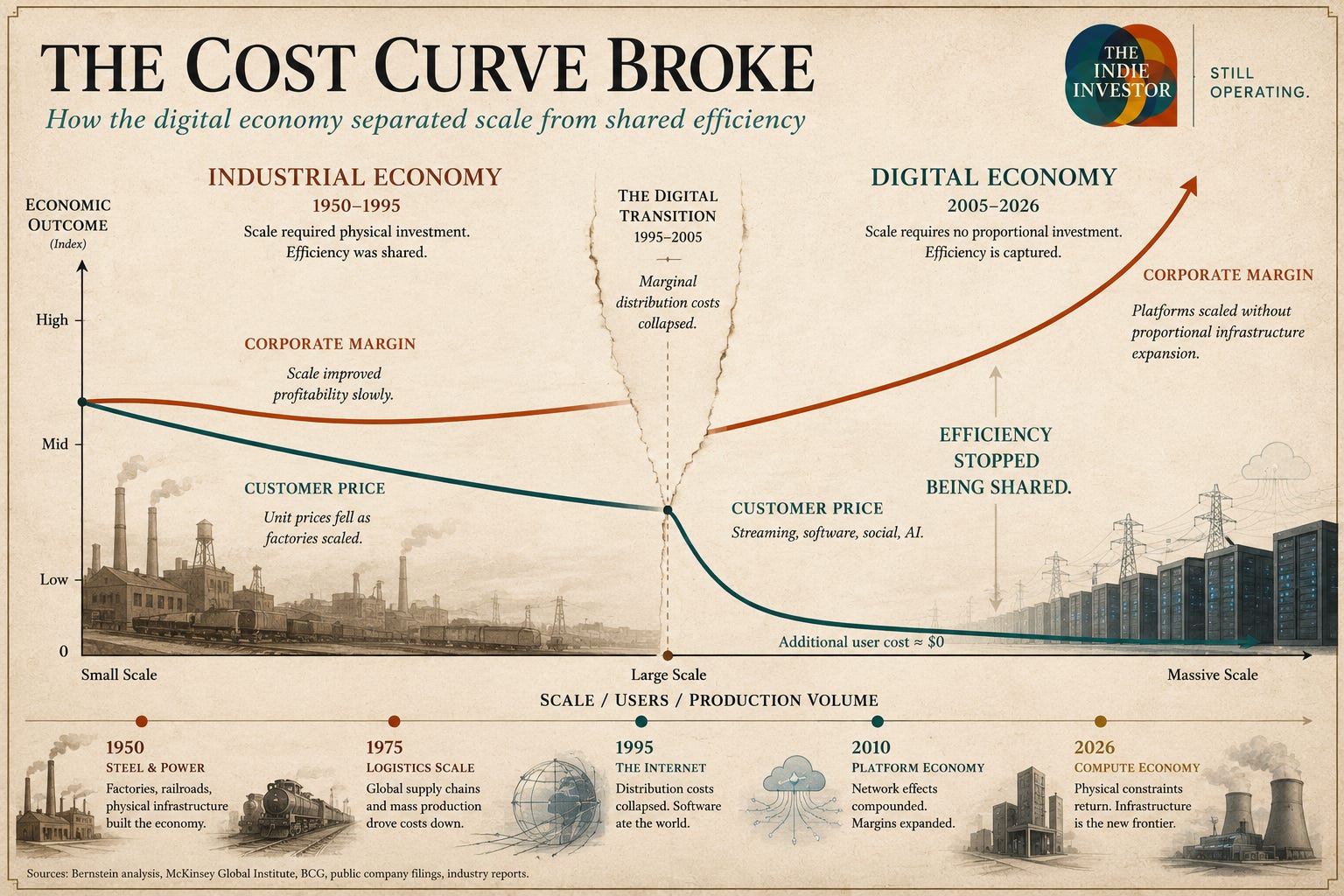
In a digital economy, marginal cost approaches zero. A SaaS company serving 100 customers or 100,000 customers incurs nearly identical infrastructure costs. An airline seat either flies full or empty; it doesn’t matter if the passenger paid $200 or $1,200. But the company’s operational complexity scales with customer diversity. Serving budget-conscious customers requires price-matching tools, complaints departments, refund processes, and aggressive customer acquisition. Serving wealthy customers requires concierge services, personalization, and attention to detail — but not necessarily more of it.
So the math has inverted. Fewer customers, higher price, lower operational complexity, higher net profit. And there are now 24 million customers in the U.S. alone who can sustain this model.
The question is: what happens to the society where the middle is no longer a viable business segment?
A price tag, then, is not an invoice. It’s a statement of intent. It’s a brand saying, “This is for you, and implicitly, this is not for them.” The brands that explicitly chose not to serve the middle in 2026 are making a wager about the future. They’re betting that the wealth concentration will continue, that the newly affluent will keep spending, and that the middle-class market will either disappear or fragment into categories so small that serving them becomes uneconomical.
The Indie Investor Field Guide: Reclaiming Your Dollars in a Shattered Tier System
The Indie Investor’s task in this moment is not to mourn the middle. It’s to understand it, and then to act against it — not through anger, but through leverage.
Here’s what you control:
1. Recognize the Signal. Stop Seeing Price as Inevitable.
When you see a price, you’re seeing a choice, not a cost. A hotel charging $400/night isn’t doing so because rooms cost $400 to provide. It’s doing so because they’ve calculated that more profit accrues from serving 50 guests at $400 than from serving 200 guests at $100. That’s not wrong—it might be optimal. But it’s useful to see it clearly.
The indie investor’s advantage is that you understand this. You’re not shocked or bitter about it. You’re reading it like data. Okay. This brand has decided I’m not their customer. The next question is: why are you still trying to be?
2. Find Brands in Transition.
Some of the best investment opportunities exist in companies that are explicitly abandoning the middle market. Why? Because Wall Street hasn’t yet priced in the consequences.
Look for brands that are raising prices, reducing quality, and restricting access. If they’ve chosen to serve a smaller, wealthier base, their path is binary: either it works spectacularly, and they compound value, or it fails spectacularly, and they collapse. There’s rarely a middle ground. The investors who understand which way it’s headed first have an edge.
This also applies inversely: look for brands that are deliberately climbing down the ladder. These are companies introducing lower-cost tiers, expanding distribution, and competing on volume. If they execute well, they capture market share from the brands that abandoned the middle.
3. Exploit the Withdrawal of Service.
When a brand prices you out, they’re also retreating from serving you. This creates opportunity. The company that serves the abandoned middle market, that makes the lounge you can actually get into, the airline seat that’s genuinely more comfortable, the credit card benefit that actually works, will capture tremendous goodwill.
As an indie investor, you have agency here. You can choose to support the brands that didn’t abandon you. You can invest in their success. You can be an early adopter of the brand that decides to win the middle market after everyone else has left it.
4. Redefine Your Loyalty by Profitability, Not Prestige.
Brands that are pricing up are extracting prestige from scarcity. They’re selling you the feeling that you’re in a club. Your job is to question whether that feeling is worth the price.
The most potent move an indie investor can make is to walk away. Not from all premium products, but from the premium products that are degrading in quality while increasing in price. The AmEx Centurion lounge is a perfect example: the product got worse and the price stayed high. This is an explicit signal that the vendor no longer respects your patronage.
There are alternatives. There are always alternatives. And the moment enough people stop seeing prestige in degraded exclusivity, that brand’s whole model collapses.
5. Watch What Happens at the Extremes.
The most interesting economic stories are written in the spaces where pricing breaks down. A restaurant with $5 appetizers and $95 entrees that serves the same crowd. A software tool with a freemium model and a $50,000/year enterprise tier. An airline with economy class and first class, but no business class.
These are the moments where you see a brand’s actual strategy. They’re not serving a continuum. They’re serving a bimodal distribution. They’ve made a choice about who they want, and everyone else is noise.
As an indie investor, you’re looking for companies where this strategy is either working brilliantly or falling apart visibly. Both are edges.
6. Own Your Defection.
Finally: there is power in deciding that a brand no longer serves you. Not because you’ve been betrayed, but because you’ve understood their calculation and chosen to take your dollars elsewhere.
The American middle class spent decades believing that shopping was a form of citizenship, that loyalty to brands was a virtue, that paying more for the same product was somehow a mark of integrity. It wasn’t. It was just good marketing.
The indie investor’s role is to strip that away. To see a price and ask: What is this actually for? Who is this actually for? If it’s not me, why am I still here?
And then, crucially: Where can I put my dollars that actually serves my interests?
That is where opportunity lives. Not in the brands pricing up, but in the market for alternatives they’re creating through their departure.
Price was once a conversation between vendor and customer about value.
It’s become a selection mechanism: a way for brands to choose their customers rather than the other way around.
But selection is a two-way street.
The brands that are pricing out the middle are creating a vacuum. That vacuum will be filled. And the indie investor who understands that physics, who sees price not as a fixed truth but as a strategic choice, will be ready when the next wave of value creation begins.
Your dollars are the only vote you get in this economy.
Use them like you mean it.
Las Vegas has done exactly this as a city. It used to provide a value prospect like cheap hotel rooms with inexpensive restaurants buried at the back of the casino. Of course, they always welcomed the 'high rollers', but now, the high rollers are their opening price point.
They want wealthy F1 groupies and oil sheiks. At some point, I believe this will tank...or at least hope it does. It's wrong and widens the chasm between the haves and the have nots.