
When the Stock Market Never Closes


Prelude: Midnight Trading Hour
The holidays arrive quietly in markets.
Out-of-office replies flicker on. Lights dim in office towers. Families gather. Flights are delayed. Someone pours another drink. Someone else finally goes offline.
But the screens don’t go dark.
Somewhere in New York, a trader born in Tokyo watches U.S. equities through the night. In Shanghai, commodity desks price American soybeans before dawn. In London, risk teams hedge exposures while the city sleeps. In crypto, of course, nothing ever stopped.
The market hums at a lower frequency, but it never disappears.
We’ve always told ourselves that markets open and close. Bells ring. Sessions begin. Holidays pause the action.
But that story has been growing less true by the year.
And now, with Nasdaq signaling a future of 24/7 trading, the pretense may finally be over.
Movement I: Why Markets Were Built to Sleep
TLDR: Markets sleep because they always have, not because they need to.
Stock market hours were never philosophical but a function of time where the mechanics required downtime.1
The earliest organized exchanges, from Amsterdam in the 17th century to London and New York centuries later, depended on physical presence. Traders had to gather in the same place, during daylight, with paper ledgers and human intermediaries. Settlement took days, sometimes weeks. Nightfall wasn’t a break. It was a constraint.
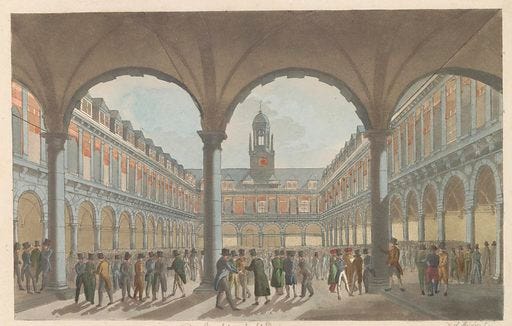
Even as technology advanced, the structure held. Telegraphs accelerated information. Phones sped execution. But clearing and settlement remained human, manual, and fragile. Limiting hours reduced risk.
When the NYSE formalized trading hours in the late 19th and early 20th centuries, it was optimizing for stability, not access. Markets needed time to reconcile books, manage errors, and reset.
Nasdaq changed that trajectory in 1971 by becoming the first electronic stock market. It removed the trading floor, digitized quotes, and set the stage for speed. But even Nasdaq inherited the rhythm of legacy systems. Settlement still lagged. Regulation still assumed sessions.
Over time, those constraints eroded. Settlement compressed from T+5 to T+3, then T+2, and soon T+1. Extended-hours trading became common around earnings. Futures and derivatives began trading nearly around the clock.
The architecture kept accelerating, and yet the clock did not.
Market hours today are less a technical necessity than a habit; instead it was a vestige of an era when human availability, not global demand, defined access.
Movement II: Why 24/7 Markets Were Inevitable
TLDR: Always-on markets didn’t start with crypto. Crypto made them unavoidable.
Crypto didn’t invent the always-on market, but it made pretending otherwise impossible.2
Foreign exchange has traded nearly 24 hours a day for decades, following the sun across time zones. Commodities markets price oil, metals, and agricultural products through overlapping global sessions. Futures markets already signal price movements long before equity markets open.
Even within equities, price discovery doesn’t wait for the bell. Earnings releases, geopolitical events, and macro data often break outside regular hours, with after-hours and pre-market trading doing much of the real work.

Crypto simply removed the illusion entirely.
For a generation of retail investors, “market closed” stopped making sense. Risk didn’t pause. Prices didn’t pause. Narratives didn’t pause. Participation became asynchronous by default.
At the same time, private markets quietly followed suit. Equity crowdfunding platforms allow capital formation at any hour. Secondary marketplaces for private shares trade continuously, without opening bells or closing auctions. Alternative investments normalized liquidity without synchronized sessions.
This matters because behavior changed before infrastructure did.
Retail investors began expecting access whenever conviction struck. Institutions began hedging exposure across asset classes that never slept. Global participants found U.S.-centric hours increasingly artificial in a multipolar financial world.
Nasdaq’s move toward 24/7 trading is not a leap forward. It is a recognition of reality.
The market already operates across time zones, cultures, and sleep cycles. The question is whether the primary exchange should reflect that truth or continue outsourcing overnight price discovery to shadows and proxies.
Movement III: The Upside and the Risk of Never Pausing
TLDR: Always-on access expands opportunity, but only if the system adapts with it.
A market that never closes changes who benefits, who bears risk, and what breaks first.
Potential Winners
Global retail investors who no longer need to conform to U.S. daylight hours
Institutions managing risk in real time rather than waiting for reopenings
Companies whose material news breaks outside traditional sessions
Liquidity providers and market makers who adapt early to overnight dynamics
Potential Losers
Thin overnight liquidity that can amplify volatility
Retail investors mistaking access for safety
Human oversight stretched across longer hours
Legacy compliance and risk frameworks built around sessions
Gaps That Must Be Filled
Incentives for overnight liquidity provision
Smarter volatility controls during low-participation windows
AI-driven market surveillance to replace absent human coverage
Education that reframes “open” as “available,” not “stable”
The danger is not that markets move while people sleep. That already happens. The danger is pretending the same guardrails apply at 3 a.m. as they do at 3 p.m.
24/7 trading widens participation. It also widens responsibility.
Finale: The Indie Investor Guide When Markets Miss Bedtime
Meditation teachers talk about finding stillness without stopping the breath.
Markets are moving in the opposite direction.
When the market never pauses, the Indie Investor can’t rely on sessions to impose discipline. There is no bell to signal readiness. No closing price to declare rest. Time becomes a variable, not a boundary.
The shift is not toward constant action. It is toward intentional participation.
In an always-on market, preparedness matters more than presence. Community intelligence matters more than solo reaction. Restraint becomes an edge, not a liability. The ability to step away without losing orientation becomes a form of mastery.
This is where the Indie Investor stops being defined by trades and starts being defined by posture.
The Indie Investor is not someone who trades at all hours.
It is someone who designs decisions for a market that does.
TLDR: When markets never close, intention becomes the new discipline.
Early Stock Markets & Physical Constraints
The Amsterdam Stock Exchange (founded 1602) operated strictly during daylight hours due to physical presence, manual ledgers, and human settlement requirements.
Source: Amsterdam Stock Exchange historical archives; Yale SOM Global Financial Crisis Project (historical market structure).
NYSE Trading Hours & Settlement
Formal U.S. stock market hours developed in the late 19th and early 20th centuries alongside paper-based clearing and human intermediaries.
Source: NYSE historical timeline; SEC “Market Structure” educational materials.
Nasdaq as the First Electronic Exchange
Nasdaq launched in 1971 as the world’s first electronic stock market, replacing physical trading floors with digital quotation and execution systems.
Source: Nasdaq corporate history; SEC exchange registration records.
Compression of Settlement Cycles
U.S. equity settlement has moved from T+5 to T+3 (1995), T+2 (2017), and T+1 (2024), reflecting decades-long acceleration of post-trade infrastructure.
Source: SEC settlement cycle reforms; DTCC documentation.
Foreign Exchange and Continuous Markets
Global FX markets operate 24 hours a day, five days a week, across Asia, Europe, and North America, enabling continuous price discovery.
Source: Bank for International Settlements (BIS) Triennial FX Survey.
Commodities and Futures Trading
Futures markets for oil, metals, and agricultural products trade nearly around the clock, with electronic platforms dominating volume.
Source: CME Group market structure documentation.
Crypto Markets as Behavioral Reset
Cryptocurrency markets trade 24/7 globally, shaping retail expectations around access, immediacy, and continuous risk exposure.
Source: Coinbase institutional research; BIS Quarterly Review on crypto market structure.
Extended-Hours Equity Trading
After-hours and pre-market trading now account for a significant share of price discovery around earnings announcements, particularly in large-cap equities.
Source: Nasdaq market data studies; academic research on earnings drift and after-hours trading.
Private Markets and Asynchronous Capital Formation
Equity crowdfunding platforms and private secondary markets allow investment and liquidity events outside traditional market hours.
Source: SEC Regulation Crowdfunding releases; industry research from PitchBook and Forge.
I agree that 24/7 markets would represent a big behavioral shift, more than the tech upgrade required. And it is true, open just means available, and not ncessarily stable.