
How Founders Lie To Investors, And Why Some Get Away With It
On startup prestige, storytelling, and the thin line between vision and fraud


Prologue: Before The Pitch
Every great company begins
with a story.
A slide deck.
A projection.
A future tense spoken fluently.
We teach founders
to sell the world that doesn’t exist yet
as if it’s already late.
“This is where we’re going.”
“This is what happens next.”
“This is inevitable.”
Applause follows clarity.
Capital follows confidence.
Somewhere along the way,
belief begins to substitute for evidence.
And the lie isn’t always false.
Sometimes it’s just early.
Movement I: Prestige Is Not a Proxy for Outcomes
Over the past decade a striking number of founders have been celebrated by Forbes 30 Under 30 to then later face criminal charges, civil fraud cases, or catastrophic business failures.
We cannot help feel like there is a pattern.

The internet treats these instances as irony and fodder to acclaim ‘eat the rich’, but entrepreneurs should understand the underlying signal.
Prestigious startups are recognized in a increasingly backwards approach that lends itself more to virtue-signaling than reaffirming value in the ecosystem. It rewards:
Narrative Clarity
Market Size Articulation
Charisma Under Uncertainty
However,
It does not reward:
unit economics
internal controls
operational durability
When the gap between the myths we tell about society and lived experience becomes too wide, then people will discard the premise of reality.
In this context, the myth isn’t of entrepreneurship or commerce, but of the players who help shape those ideals and determine the wake of the standards that comprise them.
We analyzed 30 companies from the 2015 cohort of Forbes 30 under 30, and also created a benchmark of VC-backed companies.
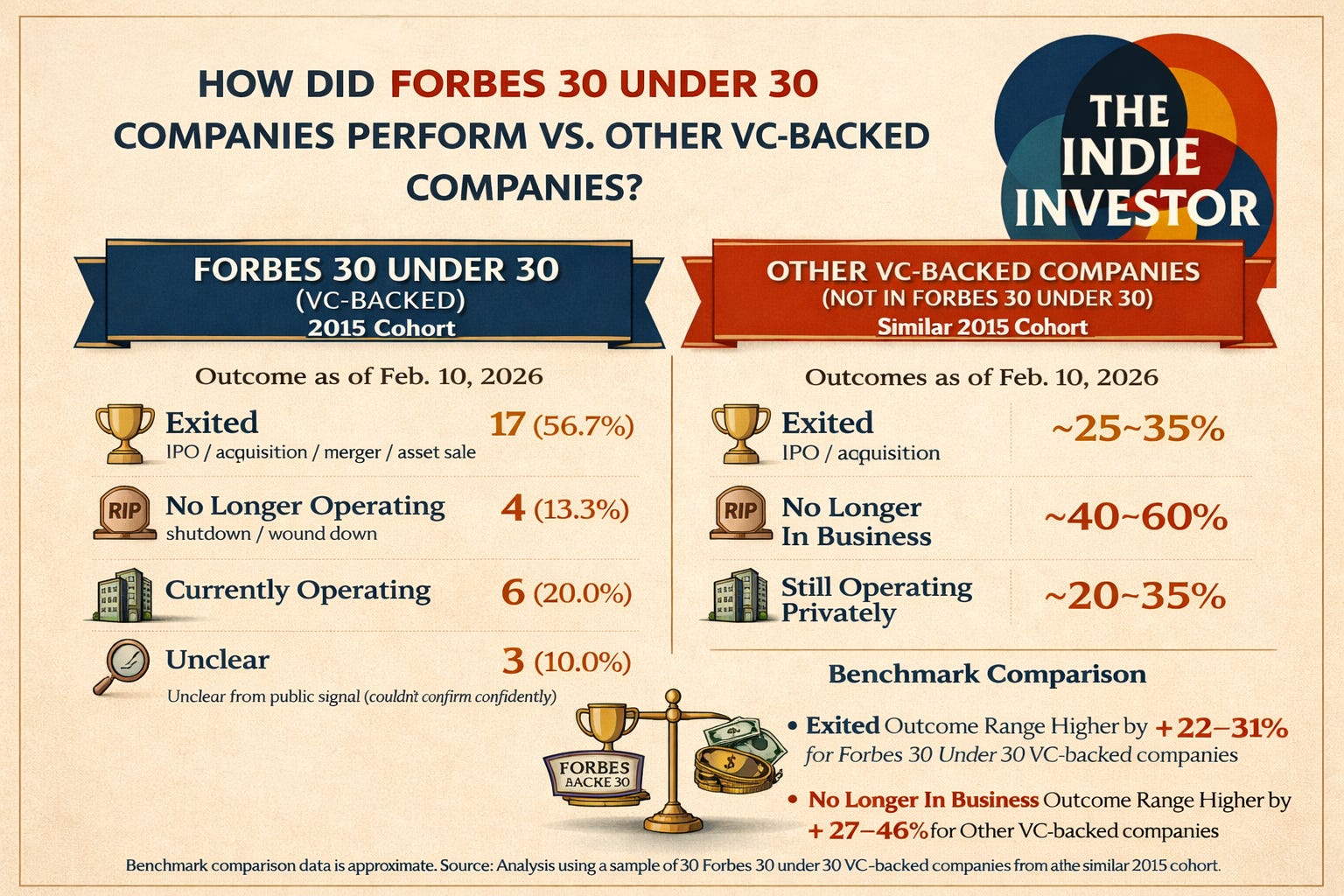
Its important not to confuse this framing with Forbes being a arbiter or enabler of cheats and criminals. The issue is the market is increasingly looking to designations as a validation method when prudent analysis should take precedence.
The point is not that Forbes creates criminals.
It’s that the market mistakes signaling for validation.
Movement II: Founders Are Trained to Speak in Futures
Founders are trained to sell a future, not report a present, but the line is crossed when projections stop adapting to reality. Vision becomes deception the moment feedback no longer changes the story.
This is the part founders rarely hear articulated clearly.
Founders are not liars by default.
They are trained rhetoricians.
From the first accelerator session to the final growth-stage roadshow, entrepreneurs are coached to speak in compressed futures. A pitch is not a balance sheet. It is a declaration of trajectory.
“We will have customers.”
“This margin will improve.”
“This bottleneck is temporary.”
These statements are not meant to describe present reality. They are meant to align belief. They are coordination language. They create shared expectation between founder, employee, and investor: they make risk legible.
In venture-backed ecosystems especially, capital is deployed not against current performance but against projected inevitability. Total addressable market. Revenue inflection. Network effects. Each is a future tense argument delivered with present tense confidence.
This is not fraud, but rather how new companies are financed.
But there is a structural tension embedded in that training. The same muscle that allows a founder to articulate a future can also blur the boundary between forecast and fact. The danger does not begin with malicious intent. It begins when:
projections harden into facts
conditional statements lose their conditions
optimism migrates from narrative into accounting
A slide that once read “projected” becomes a dashboard labeled “pipeline.” A delayed contract becomes “imminent revenue.” A customer trial quietly becomes “enterprise adoption.” The language shifts subtly, often incrementally, and each shift feels defensible in isolation.
The crucial distinction is this:
The line between vision and deception is not intent but rather feedback.
Healthy storytelling is adaptive. It absorbs new information and revises the narrative accordingly.
If customer acquisition costs spike, the story changes.
If churn rises, the roadmap shifts. The future is still sold, but it is sold with updated assumptions.
Deceptive storytelling resists feedback. It protects the original arc at all costs. Data becomes an obstacle to narrative continuity rather than an input. Missed milestones are reframed instead of examined. The company stops asking, “What is happening?” and starts asking, “How do we explain this?”
This is where myth enters the room.
Myth, in its classical sense, is not a lie. It is a story that organizes belief. Founders need myth. Employees join because of myth. Investors allocate because of myth. Markets reward myth.
Fabrication is something else entirely. Fabrication is when the myth refuses contact with evidence. It is when internal metrics are adjusted to preserve morale. When external updates smooth volatility into certainty. When the story is no longer an aspiration but a shield.
Myth inspires effort.
Fabrication avoids consequence.
The tragedy in many high-profile startup collapses is not that founders told bold stories. It is that they stopped letting reality revise those stories. What began as ambition calcified into narrative protection. The pitch deck, once a sketch of possibility, became a defense brief against inconvenient facts.
Selling the future is part of the job, and inventing the present is not.
The founders who endure are not the ones who never overstate. They are the ones who recalibrate early, publicly, and often. They understand that credibility compounds the same way capital does: through alignment between story and signal.
The moment feedback is treated as betrayal rather than information, the story ceases to be a forecast. It becomes a fabrication.
And fabrication, unlike myth, does not survive scrutiny.
Movement III: The Lie That Gets You in Trouble Is the One You Start Believing
Founders don’t get in trouble for bold vision; they get in trouble when they start defending the story in spite of the numbers. The real danger begins when narrative stops adjusting to reality and becomes something that must be protected at all costs.
The founders who end up in headlines rarely begin as villains. They begin as protectors. Protectors of morale. Protectors of valuation. Protectors of the story that once unlocked belief and excitement.
In the early days, distortions feel temporary, maybe even strategic.
A delayed contract becomes “strong pipeline.” Rising churn is contextualized inside a carefully chosen cohort. Cash burn is reframed as “intentional investment in growth.” Each explanation contains a kernel of truth. Each buys time. Each preserves momentum.
Individually, these moves are defensible. Collectively, they begin to bend reality.
The psychological shift is subtle but decisive. At first, the founder is persuading others. Over time, the founder is persuading themselves. The narrative that once organized effort becomes something that must be defended. Data stops functioning as signal and starts functioning as threat.

This is how insulation forms. Board decks get cleaner as operations get messier. Internal dashboards are curated. Language tightens. “Projected” quietly disappears. The gap between story and fact widens, but no single step feels like a leap.
At some point, the founder becomes the last person in the room still defending the fiction.
And this is where real trouble begins.
Incarceration stories are rarely born from bold vision. They emerge from refusal—refusal to reconcile narrative with numbers, refusal to surface deterioration, refusal to admit that the future has shifted. The original pitch may have been ambitious. The downfall begins when ambition hardens into denial.
The most dangerous lie in startups is not the one told to investors. It’s the one told internally after the numbers arrive. Because once reality is treated as negotiable, everything else soon follows.
Finale: The Indie Investor / Founder Field Guide
How to “Lie” Without Crossing the Line
Startup ecosystems reward conviction. They reward founders who speak clearly about futures that do not yet exist. But the same skill that unlocks capital can quietly undermine credibility if it’s left unchecked. For those building, funding, or advising companies, the goal is not to eliminate ambition. It’s to anchor it.
Preserve the conditional tense.
If something depends on execution, say so. Repeatedly. “We will” is powerful, but “We will if” is honest. Conditionals are not weakness; they are intellectual discipline. Investors understand risk. What they distrust is inevitability without contingency.Separate storytelling from reporting.
A pitch deck is a projection. An investor update is a record. When those two documents begin to sound the same, trouble is already forming. Futures belong in forward-looking slides. Facts belong in performance summaries. Do not merge them for the sake of momentum.Let reality revise the narrative.
Markets shift. Customers churn. Margins compress. The founder who adjusts the story in response to data builds long-term trust. The founder who protects the original arc erodes it. Updating your thesis is not an admission of failure. It is proof of control.Prestige is not permission.
Recognition, media coverage, awards, or inclusion on prestigious lists do not relax the obligation to accuracy. Visibility amplifies responsibility. The brighter the spotlight, the tighter your internal controls must become.If you feel pressure to hide data, stop pitching.
The moment capital requires concealment—of churn, burn, delays, or losses—the company is no longer negotiating valuation. It is negotiating integrity. Pause. Surface the truth. Reset expectations before the gap widens.