
Back to the Door: The Return of the Referral
How Referrals Are Quietly Replacing Résumés in an AI-Driven Job Market


Prelude: At The Threshold
The city is hiring, but not the way it says it is.
Glass towers blink Open to Work
like vacancy signs that never turn green.
We walk past cranes frozen mid-sentence,
coffee shops buzzing with founders
who swear the slowdown is “temporary,”
and job boards that scroll like slot machines—
lever pulled, dopamine denied.
Somewhere, an algorithm skims our lives
down to verbs and gaps,
judges our worth in milliseconds,
then hands the verdict to another machine
trained on yesterday’s layoffs.
We were told this was efficiency.
We were told this was progress.
But listen closely
beneath the hum of GPUs and résumé parsers,
you can hear something older clearing its throat:
a conversation,
a referral,
a name passed hand to hand like a match.
The future, it turns out,
is knocking on doors it never fully replaced.
Movement I: A Job Market Built for Machines, Not People
TLDR: This job market isn’t just tight—it’s structurally distorted by automation evaluating automation.
By most conventional measures, the current job market, and particularly for tech and white-collar workers, is the most challenging it has been in over two decades.
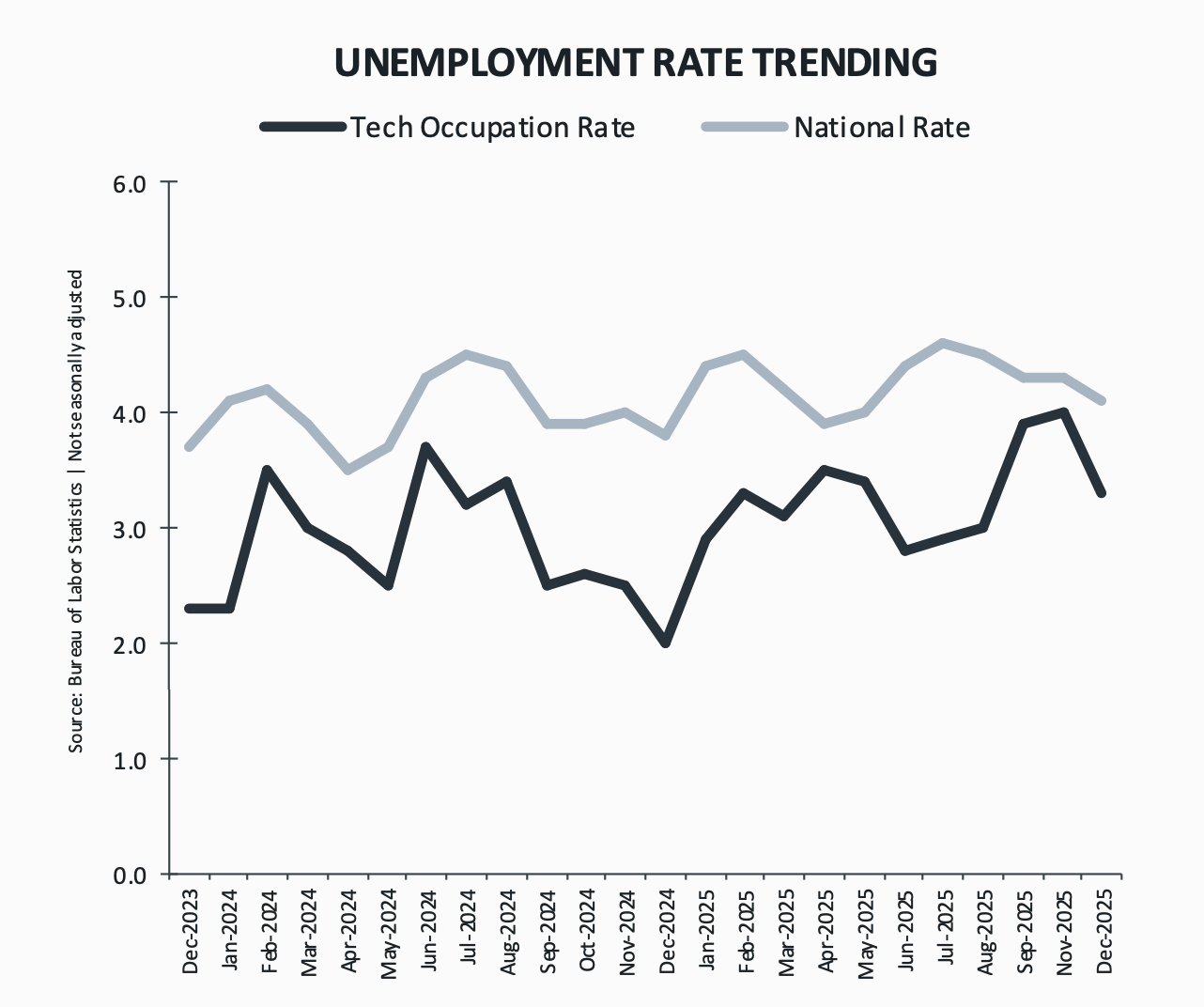
Unemployment among tech workers has risen meaningfully compared to the post-pandemic boom, with some estimates placing tech-sector unemployment near or above levels last seen during the early 2000s downturn. Job openings across major platforms have declined sharply year-over-year, while applicant volume per role has surged: often 2–3× higher than pre-2022 norms.
But the real distortion isn’t just macroeconomic but rather a procedural one for the application process.
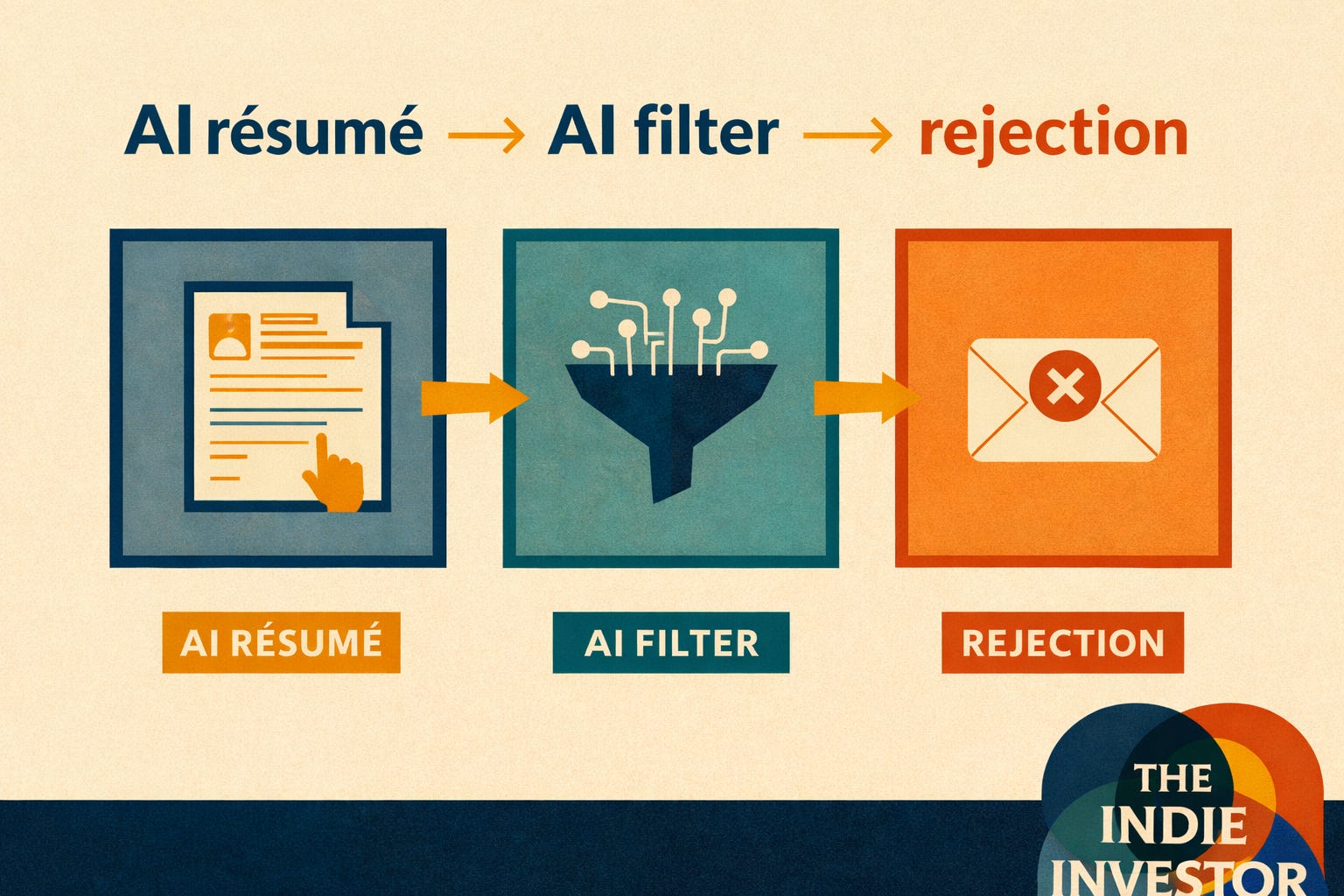
Artificial intelligence now sits on both sides of the hiring pipeline. Candidates increasingly rely on AI to tailor résumés, draft cover letters, and optimize applications. Recruiters, in turn, use AI-powered applicant tracking systems to filter, rank, and reject candidates at scale.
The result is a closed loop: Machine-generated applications evaluated by machine-trained filters.
Some estimates suggest over 70% of résumés submitted for corporate roles are never seen by a human, rejected automatically based on formatting, keyword density, or inferred fit. In certain industries, that number is even higher.1
What’s lost in this process is context — career arcs that don’t read linearly, skills learned sideways, people who don’t optimize well but perform exceptionally.
For job seekers, this doesn’t feel abstract. It feels personal. Rejections arrive within minutes. Applications disappear without acknowledgment. The act of applying becomes less about communicating potential and more about appeasing a system that doesn’t explain itself.
This is efficiency without empathy and a scale that goes without signal.
Movement II: Why Old-School Hiring Is Quietly Returning
TLDR: As automated hiring floods the market with noise, trust-based hiring is regaining value.
There’s a quieter countertrend emerging beneath the surface of job boards and AI tools.
Referrals now account for a disproportionate share of successful hires, even as they represent a minority of total applications. Various industry surveys show that referred candidates are 3–5× more likely to be hired than non-referred applicants — and they tend to stay longer once hired.
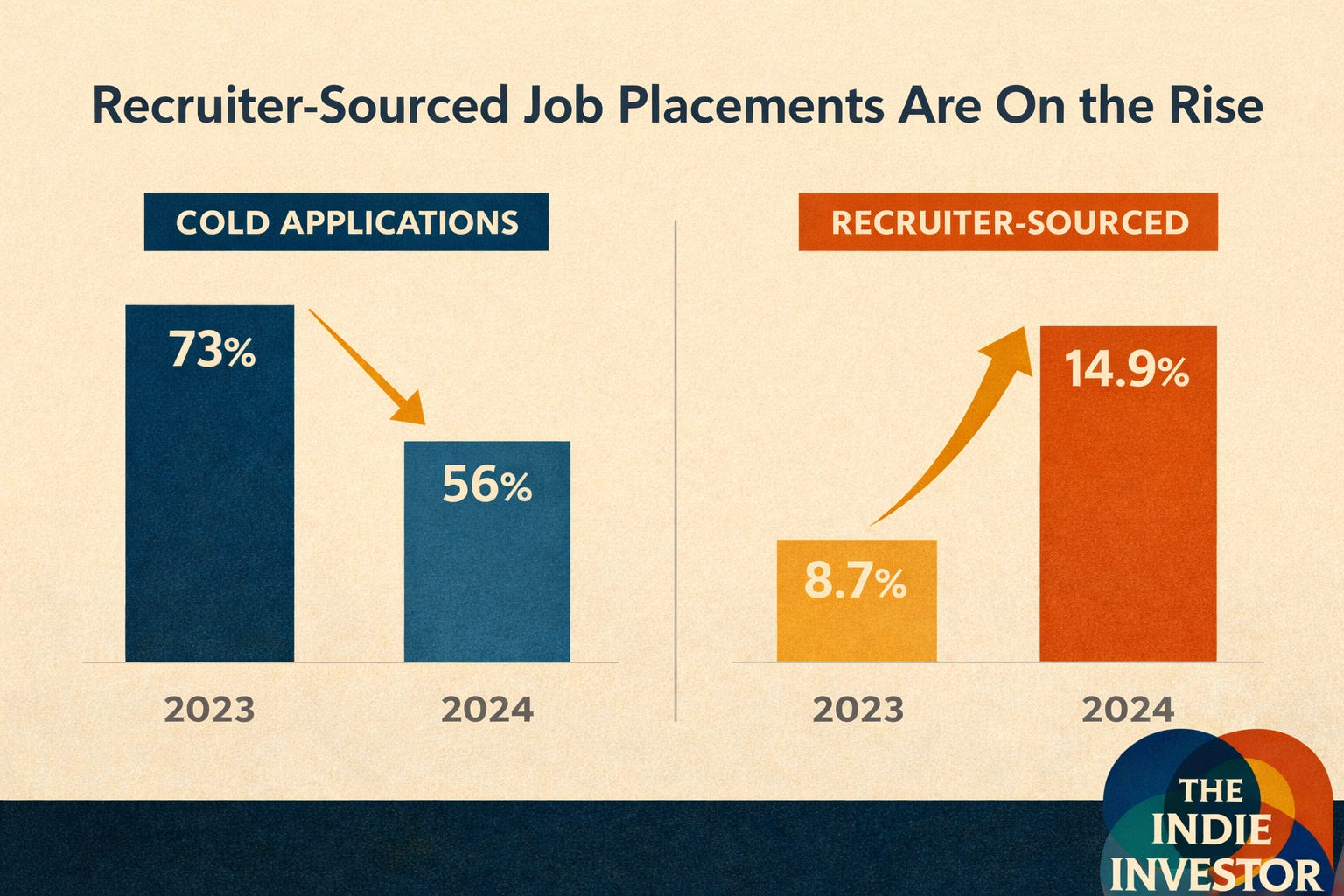
At the same time, companies are increasingly outsourcing hiring to boutique recruiting agencies and trusted intermediaries. These firms don’t promise reach but instead filtration for a onslaught of applicants.
Why the shift?
Because scale has broken differentiation.
When hundreds of applications arrive polished by similar AI tools, hiring managers struggle to distinguish signal from surface;
Résumés converge.
Language homogenizes.
Everyone looks “qualified.”
So employers seek judgment elsewhere;
They ask who can vouch.
Who has been seen working.
Who arrives with context attached.
Small recruiting firms, internal talent partners, and operators hiring quietly now function as market makers; not of labor supply, but of trust.
The Indie investor wrote further on this imposition and its deeper connections to AI in a previous article.

In this environment, many jobs are never posted publicly at all. They move sideways through conversations, recommendations, and human discretion.
The algorithm didn’t replace the door.
It just made the side entrance more valuable.
Movement III: Why This Moment Feels So Heavy
TLDR: The frustration people feel reflects a broken promise—not individual failure.
What makes this job market uniquely exhausting isn’t only the scarcity of roles but the psychological whiplash.
For years, workers were encouraged to invest in skills, embrace technology, and build adaptability as a form of career insurance. Many did exactly that only to find themselves filtered out by systems designed for efficiency, not judgment.
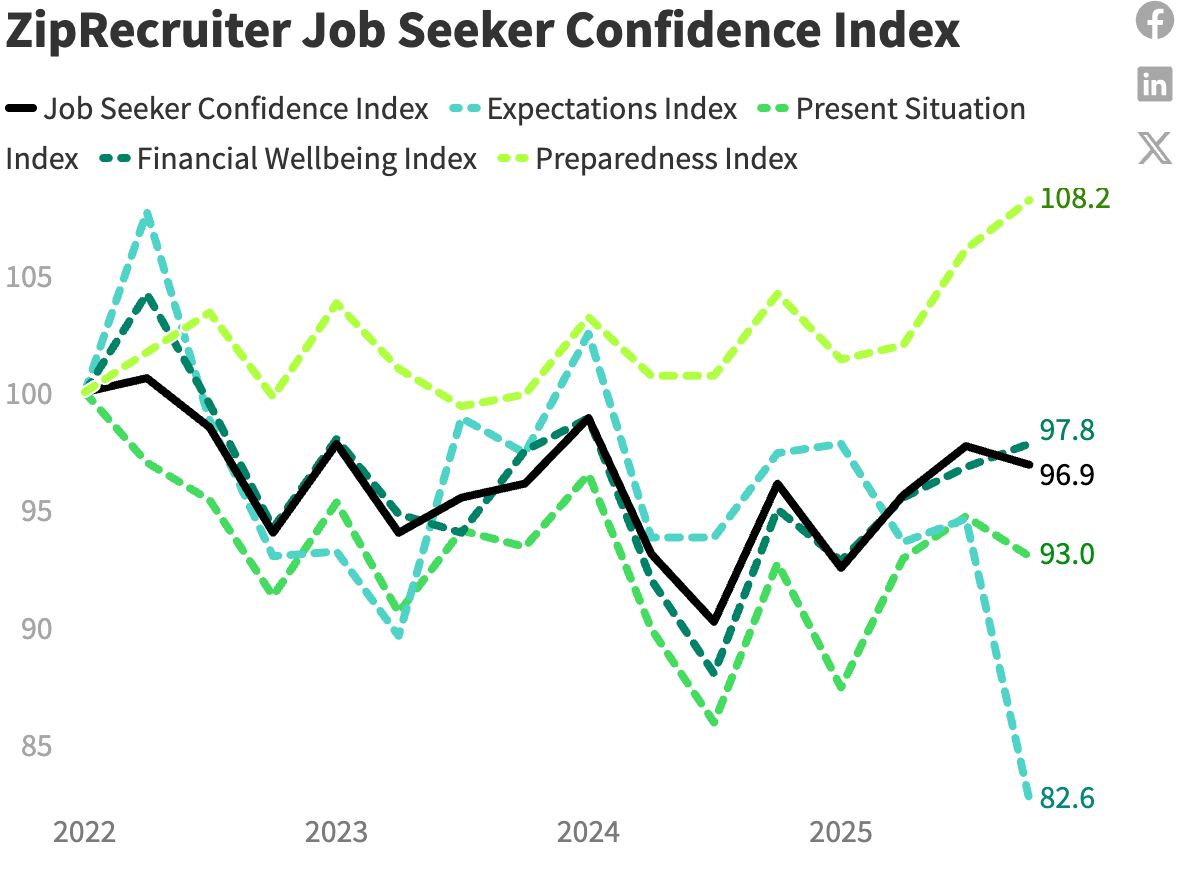
Surveys now show that job seekers report record-high levels of burnout and disengagement, even among those currently employed. A growing share of professionals describe job searching as emotionally taxing, demoralizing, and opaque words rarely associated with opportunity.
Meanwhile, companies are acting rationally within the incentives they face. Automation reduces costs. Optionality favors employers. Risk is externalized onto workers.
This isn’t a moral failing but a confirmation of a market structure that has been incentivized and reaffirmed with every technological developments.
From an Indie Investor perspective, this moment mirrors others we’ve seen in capital markets: when systems become too optimized, agency migrates elsewhere. Alpha doesn’t disappear—it relocates.
Right now, leverage lives less in tools and more in relationships. Less in optimization and more in visibility. Less in compliance and more in context.
The confusion many people feel isn’t weakness.
It’s pattern recognition lagging behind structural change.
Finale: The Indie Investor Field Guide to Finding Work Now
This isn’t a rejection of technology. It’s a recalibration of strategy.
Across hiring data, one trend is consistent: relationships compress uncertainty faster than credentials.
For those navigating this environment, a few principles are emerging clearly.
First, networks behave like long-duration assets. They compound slowly, then all at once. Consistent presence—thoughtful follow-ups, visible curiosity, shared work—outperforms high-volume outreach.
Second, strategic de-optimization matters. A résumé designed solely for machines often reads as forgettable to humans. Clarity, specificity, and narrative now outperform keyword density.
Third, smaller gatekeepers matter more than platforms. Boutique agencies, internal recruiters, and operators hiring quietly now control disproportionate access to real opportunity.
Fourth, observable work travels farther than static credentials. Writing publicly, building in the open, sharing thinking in progress—these create signal in a market drowning in polish.
Finally, zoom out. Markets recalibrate. Labor cycles reset. Systems that feel exclusionary today will eventually overcorrect.
The résumé isn’t dead.
It’s just no longer the door.
Glassdoor Economic Research, “AI Has Not Killed Online Job Applications” (2024–2025).
Data reflects changes in job offer sources and recruiter-sourced candidate share, including a decline in cold-application-led offers from a 2023 peak (~73%) and a ~72% increase in recruiter-sourced candidates since 2023 (to ~15%).